


When winter evenings stretch longer and homework sessions push deeper into darkness, most parents instinctively reach for the brightest lamp they can find. It seems logical: more light equals better visibility, which must mean healthier eyes. But this well-intentioned reflex often backfires, creating a cascade of problems that can disrupt sleep patterns, strain developing eyes, and even make concentration harder.
The mistake isn't caring too much—it's misunderstanding how light actually works in a child's study space during those dark winter months.
The Three Most Common Winter Study Lighting Mistakes Parents Make
Mistake #1: Equating Brightness with Eye Safety
Many parents chase lux values like they're shopping for the highest thread-count sheets, assuming that a lamp advertising 1,000 lux must be twice as good as one offering 500 lux. But according to the Illuminating Engineering Society's guidelines for residential task lighting, children's homework areas need between 300-500 lux at the desk surface—not the nuclear-bright levels some marketed "study lamps" deliver. Excessive brightness creates harsh contrast between the illuminated desk and the surrounding room, forcing young eyes to constantly readjust. This contrast adaptation puts unnecessary strain on the ciliary muscles that control focus.
Mistake #2: Ignoring Direct Glare and Desktop Reflections
Standard desk lamps often position the LED array directly in a child's line of sight when they look up from their textbook. This direct glare—even from a "warm white" bulb—triggers an involuntary pupil constriction response. When your eight-year-old repeatedly glances between a glossy worksheet and an exposed light source just 18 inches away, their pupils are constantly dilating and contracting. Compound this with reflective glare bouncing off white paper or tablet screens, and you've created a miniature stroboscopic workout for developing eyes during a two-hour homework session.
Mistake #3: Using Cool-Temperature LEDs After Sunset
Here's where the blue-light conversation gets hijacked by marketing. Parents see "blue light blocking" stickers and assume they've solved the problem. But the issue isn't eliminating all blue wavelengths—it's about circadian timing. Research published in the Journal of Clinical Sleep Medicine indicates that exposure to light with color temperatures above 4000K after 8 PM can suppress melatonin production in children by up to 50%. Yet many popular desk lamps default to 5000K-6500K "daylight" settings because they photograph well and seem "clinical." When a ten-year-old finishes math homework at 9 PM under a 6000K lamp, they're essentially telling their brain it's still midday, potentially delaying sleep onset by 30-60 minutes.
Why Higher Lumens Don't Equal Better Eye Protection
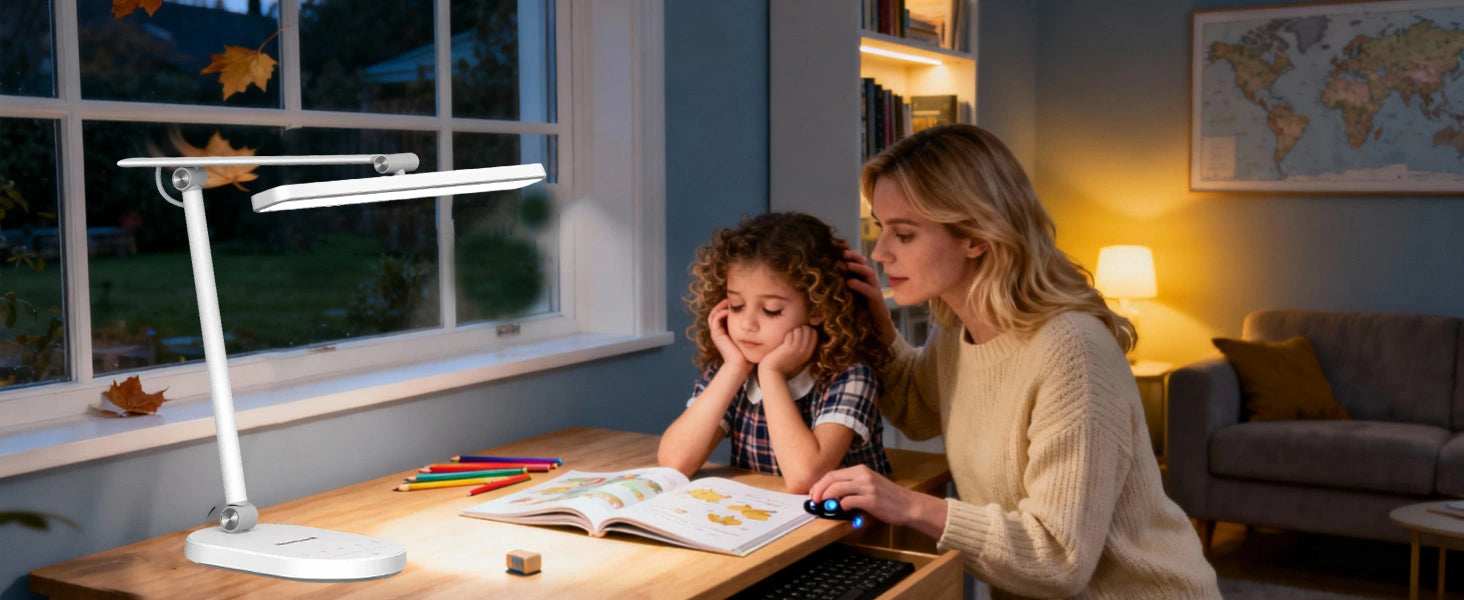
The lighting industry has trained consumers to shop by numbers—watts, lumens, lux—but these metrics tell you nothing about light distribution, which is what actually determines comfort and safety. A lamp emitting 800 lumens concentrated in a 60-degree beam creates a completely different visual environment than the same 800 lumens diffused across 120 degrees.
Think of it this way: would you rather have a flashlight aimed at your child's face or that same light filtered through a lampshade? Both deliver the same total light energy, but one is unusable and potentially harmful.
For winter homework sessions that often extend 90-120 minutes, what matters is achieving even illumination across the work surface without hotspots (areas of excessive brightness) or shadows that force awkward postures. The American Optometric Association recommends that task lighting be no more than three times brighter than surrounding ambient light. When the rest of your living room is dimly lit in winter evenings, that ultra-bright desk lamp creates exactly the contrast gradient that causes eye fatigue.
What Actually Matters: Offset Optics, Gradual Light Transition, and Adaptive Dimming
Let's translate lighting engineering into parent-friendly concepts:
Offset optical paths mean the LED chips aren't pointing straight down like a spotlight. Instead, the light bounces off reflective surfaces inside the lamp head before reaching the desk. This indirect approach eliminates that central hotspot and creates a broader, softer pool of light. Imagine the difference between holding a candle directly over a book versus placing it behind a frosted glass panel—same light source, radically different experience.
Gradual light transition addresses the pooling problem. Many desk lamps create a sharp circle of brightness with an abrupt falloff at the edges. When your child's peripheral vision constantly registers this dramatic light-to-dark boundary, it triggers subtle stress responses. Quality task lighting should fade gradually, creating a visual gradient rather than a spotlight effect. This becomes especially important in winter when the contrast between the lit desk and dark windows is already pronounced.
Adaptive dimming isn't about luxury—it's about circadian hygiene. As evening progresses, the ideal desk lamp should allow easy adjustment from task-appropriate brightness (around 400 lux) early evening to a warmer, dimmer setting (200-250 lux at 2700K-3000K) as bedtime approaches. This gradual transition helps maintain the natural melatonin production curve rather than crushing it with sustained cool, bright light.
Practical Placement Guidelines for Winter Study Zones
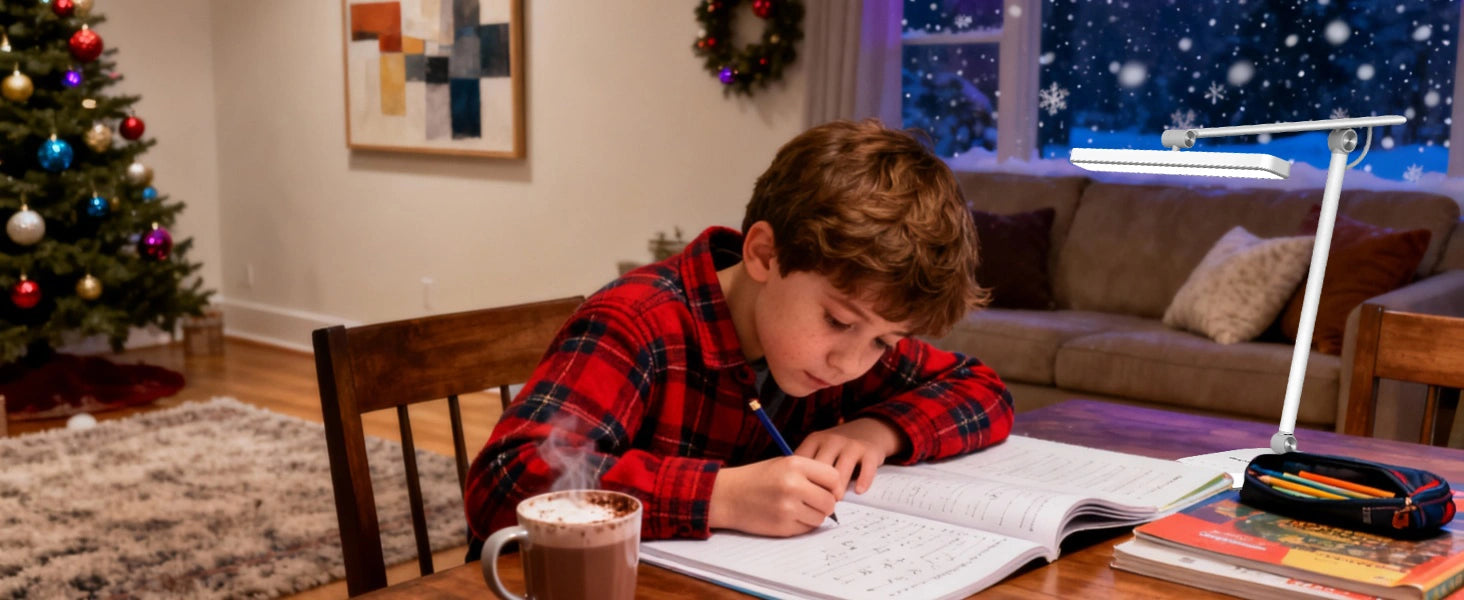
Position before purchase: Before buying any desk lamp, sit where your child will sit and note where their eyes naturally land when looking up from a book. The lamp head should never be in this sight line. Ideally, position the lamp to the left side for right-handed children (and vice versa) at a distance of 15-18 inches from the desk center.
Measure the work zone: Children's homework often sprawls—textbook, worksheet, laptop, notebook simultaneously. Measure this actual usage area (typically 20 inches x 14 inches) and ensure your lamp can cover it evenly. A concentrated beam that illuminates only an 8-inch circle will force constant repositioning.
Control ambient light: In winter's early darkness, don't leave the rest of the room pitch black. A dim overhead fixture or corner lamp providing 30-50 lux of ambient light prevents the harsh contrast that causes eye strain. This background lighting shouldn't cast shadows on the desk but should keep the room from feeling like a cave.
Account for screens: If homework involves a laptop or tablet, position the desk lamp to avoid reflections on the screen. This usually means lighting from the side rather than directly above or behind the monitor.
Distance from wall: Place the desk lamp at least 8 inches from the wall behind the desk. Light bouncing off a close wall creates secondary reflections and hotspots that undermine the lamp's optical design.
A Reusable Framework for Evaluating Any Children's Study Lamp
When you're standing in an aisle or scrolling through product listings, these quick checks will help you avoid the common pitfalls:
Can you see the LED chips directly when seated? If yes, keep looking. Exposed LEDs mean direct glare.
Does it offer stepless dimming or just 3-5 brightness modes? Preset modes rarely match real-world needs. Continuous dimming lets you fine-tune.
What's the CRI (Color Rendering Index)? Anything below 90 distorts how colors appear, which matters for art homework and reading comprehension. Both Honeywell models maintain CRI >95.
Is the color temperature adjustable, and does it go warm enough? Fixed 5000K lamps are problematic for evening use. Look for 4000K capability as a minimum.
How stable is the base? A desk lamp for children will get bumped. Check the base diameter (should be at least 7 inches) and weight distribution.
Can children operate it independently? Touch controls beat fiddly switches. Memory functions beat having to recalibrate every evening.
Winter's darkness amplifies every lighting choice you make. The goal isn't to create a hospital-bright workspace—it's to provide adequate, comfortable illumination that supports both homework completion and healthy sleep patterns. That means rejecting the "brighter is better" impulse and instead focusing on light quality, distribution, and circadian appropriateness. The few extra minutes spent understanding these principles will pay dividends in reduced eye fatigue complaints and smoother bedtime transitions all season long.


