


Section 1: Spring Is a Biological Reset — Not Just a Calendar Change
Every March, something shifts. Daylight lingers past 7 p.m., morning skies brighten earlier, and most of us notice a distinct lift in energy and mood. This is not coincidence. Light is the primary signal your brain uses to regulate the body's internal clock — what sleep scientists call the circadian rhythm — and the seasonal lengthening of daylight is one of the most powerful biological resets the human body experiences all year.
Research in sleep medicine and chronobiology consistently shows that the timing, intensity, and spectrum of light entering the eye directly influences melatonin production, cortisol release, and alertness cycles. When spring arrives and natural daylight exposure increases, many people spontaneously adjust their sleep schedules, feel more motivated in the mornings, and find it easier to focus during the day. The mechanism is well-documented: brighter, cooler-spectrum light in the morning suppresses melatonin and promotes wakefulness, while dim, warmer light in the evening triggers the hormonal wind-down that precedes sleep.
But here is the problem most of us overlook: the positive biological reset that spring triggers relies almost entirely on outdoor light. The moment you step back into a home or home office lit by a standard LED bulb or incandescent lamp, you are operating under light conditions your body was never designed for. The average indoor light level in an American home measures roughly 50 to 200 lux — a fraction of the 2,000+ lux of a cloudy spring morning outdoors. For the more than 50% of Americans who now work from home at least part of the time, this indoor light deficit is no longer a minor inconvenience. It is an all-day physiological mismatch.
Section 2: Mood Lighting vs. Functional Lighting — Why Ambience Alone Falls Short
Walk into any interior design showroom and you will find a language built almost entirely around atmosphere — warm Edison bulbs, soft pendants, dimmable accent strips. Ambience lighting is genuinely beautiful, and it has a rightful place in any well-designed home. But when the conversation stops there, something critical is lost.
Mood lighting is designed to make a space feel a certain way. Functional lighting is designed to support what you actually do in that space. These are not the same goal, and conflating them leads to a home where you feel cozy but cannot concentrate, where reading strains your eyes after twenty minutes, and where the visual fatigue you attribute to screen time is actually caused by chronic under-illumination and poor light quality.
The key distinction lies in two measurable properties. The first is illuminance — simply how much light reaches your work surface, measured in lux or foot-candles. The Illuminating Engineering Society recommends at least 30 to 50 foot-candles (roughly 320 to 540 lux) for sustained reading and desk work. Most ambient lighting setups fall well below this threshold. The second is color rendering — how accurately a light source reproduces the true colors of objects, expressed as a Color Rendering Index (CRI) score. Sunlight scores a perfect 100. Standard warm-white LED bulbs typically land between 70 and 80, meaning the light you work under every day is subtly distorting color and reducing the visual contrast your brain relies on to process information efficiently.

Section 3: How Light Influences Your Daily Rhythm — Morning to Night
Understanding the relationship between light and the circadian rhythm has direct, practical implications for how productive your mornings are, how well you concentrate at 3 p.m., and how easily you fall asleep at 11 p.m.
Morning (7 AM – 10 AM): The Alertness Window
Bright, cool-white light (roughly 4,000K–6,500K) in the morning accelerates cortisol production and suppresses residual melatonin, shifting the body into an alert, focused state more quickly. Studies in occupational health and lighting science have found that workers exposed to higher-intensity, cooler-spectrum light in morning hours reported better concentration scores and fewer self-reported errors compared to those under standard residential lighting. For work-from-home setups, replicating this signal indoors is one of the most evidence-backed adjustments you can make.
Midday (11 AM – 2 PM): The Stability Phase
Around midday, natural light reaches peak intensity. Maintaining adequate illumination during this window helps sustain the cortisol curve and avoid the mid-afternoon energy dip many people incorrectly attribute solely to food. A consistent, well-distributed light source that minimizes shadows and glare reduces the micro-visual stress that accumulates over hours of desk work.
Evening (7 PM onward): Wind-Down and Melatonin Onset
This is where most modern homes get into trouble. Blue-enriched light from screens and overhead LEDs after 8 p.m. has been extensively studied in relation to delayed melatonin onset, reduced sleep quality, and next-day fatigue. Switching to warm, dim ambient sources in the evening — and avoiding bright task lighting — allows the body's melatonin system to function as designed.
Section 4: From a Single Lamp to a Lighting System — Ambient, Task, and Rhythm
The most impactful shift in home lighting thinking is moving from "which lamp should I buy?" to "what kind of light environment am I building?" A well-designed residential lighting system works in three layers:
Layer 1 — Ambient Light: The foundational, room-wide illumination that replaces what you would otherwise get from windows. Should be consistent, shadow-free, and adequately bright without glare.
Layer 2 — Task Light: Directed, high-CRI light positioned for reading, writing, or close work. Critical for reducing eye strain during sustained focus sessions.
Layer 3 — Rhythm Light: Time-of-day aware lighting — brighter and cooler in the morning, stepped down in the evening. The layer most people are missing, and the one with the greatest long-term impact on sleep quality.
Most off-the-shelf lamps address only one of these layers at a time. The challenge — and the opportunity — lies in finding an anchor piece that serves as both primary ambient illumination and high-quality task light throughout the day, with the output range to also step back in the evening. This is exactly where the category of full-spectrum floor lamps has evolved most significantly.
Section 5: The Importance of a Stable Light Source — Reducing Visual Stress Over Time
There is a meaningful difference between buying a lamp and building a light environment. The former is a transaction; the latter is an investment in a daily physical condition that quietly shapes your cognitive performance, mood regulation, and sleep quality every night.
Research in environmental psychology has consistently found that people working under high-quality, consistent lighting report lower perceived visual fatigue, better sustained attention, and improved mood over multi-week periods compared to those under standard residential lighting. The effect is not dramatic day to day — it operates more like nutrition than medication — but it compounds in ways that are genuinely significant over months of daily use.
When your eyes are not working to compensate for glare, excessive shadow contrast, or poor color rendering, the cognitive bandwidth freed up is real. Accumulated across a year of work-from-home days, it represents a material difference in how much energy you have left at 5 p.m. — and how quickly you fall asleep at 11 p.m.
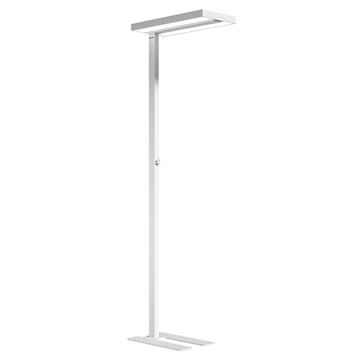
This is where a full-spectrum floor lamp like the Honeywell 02E distinguishes itself in practice. Its large rectangular panel combines upward and downward light emission — using ceiling diffusion and a high-density micro-prism crystal diffuser — to produce room-filling, shadow-minimizing illumination covering up to 258 sq ft. Output runs from 6,000 to 16,000 lumens depending on the model variant, all linearly adjustable from 10% to 100% brightness via a precision rotary knob. That tuning range is what allows a single lamp to function across the full arc of a daily rhythm — from full working brightness in the morning to a dimmed, gentle presence in the evening.
The 02E is built around Honeywell Smart Lighting's proprietary SUNTURALUX™ chip, co-developed with Bridgelux, and engineered to replicate the visual and physiological qualities of natural sunlight indoors. Its fixed 4,000K color temperature is calibrated to approximate natural daylight at 10:00 a.m. Greenwich Mean Time — a deliberate design choice for use during the active, productive phase of the day. On color fidelity, the lamp achieves a CRI of 98, with a color fidelity score (Rf) above 97 across 99 color samples — meaning objects, faces, and printed materials viewed under this light appear virtually identical to how they look in natural outdoor daylight.
Safety certifications include TÜV Rheinland, EU blue-light safety ratings at Risk Group 0 (RG0 — the safest classification), and a flicker depth of 0.00% per the IEEE PAR 1789 standard. These are not marketing footnotes — they are the conditions that make extended daily use genuinely comfortable rather than gradually fatiguing.

Section 6: Building a Long-Term Lighting Strategy — Scene Planning Across the Day
Putting these principles into practice starts with one well-chosen anchor light source and a simple daily routine built around it.
Morning (7–9 AM) — Full Output / Alertness Mode: Set your primary floor lamp to 80–100% brightness in the room where you have your morning coffee or start your workday. The bright, natural-spectrum light signals morning to your brain in a way that no warm-white overhead bulb can replicate.
Work Block (9 AM – 5 PM) — Task / Focus Mode: Maintain 70–100% brightness. Position the lamp so it provides even ambient illumination behind or beside your monitor, reducing the contrast ratio between screen and room that accumulates into eye fatigue over long sessions.
Evening Transition (6–8 PM) — Reduced Output / Wind-Down: Begin stepping down to 30–50% brightness as you move into the evening. Pair with warmer accent lighting if desired. A dimmed full-spectrum source alongside warm-toned accent light provides comfortable illumination without the melatonin-suppressing effect of sustained bright exposure.
Night (9 PM onward) — Minimal or Off: Switch your primary lamp off or to its lowest setting (10%). Use warm bedside lighting only. Protect the final 90 minutes before sleep from any bright overhead source.
The most effective lighting systems are the ones that actually get used — consistently, daily, over months and years. A lamp that earns a permanent place in your daily environment, rather than being pushed into a corner because it is too harsh or too dim or too visually intrusive, is the one that ultimately makes the difference. Hardware determines what is possible; habit determines what gets used.


