


The Real Meaning of Spring Decluttering
Every spring, millions of households across North America and Europe engage in the familiar ritual of decluttering. Closets are emptied. Shelves are cleared. Old lamps — the ones that flickered too much, looked dated after two seasons, or whose bulbs vanished from store shelves — are sent to the curb.
But a subtle shift is underway. The conversation around minimalism is evolving from aesthetic minimalism — the clean, sparse interiors that flood design feeds — toward something far more substantive: functional minimalism. The question is no longer simply "how little can I own?" but rather, "which items are worth owning permanently?"
Lighting is one of the most frequently replaced household items — and one of the least examined at the point of purchase. Research from environmental design departments at several European universities suggests that the average household replaces a floor lamp every three to five years, primarily due to style obsolescence, bulb discontinuation, or structural failure. Over a decade, that cycle generates real cost, real waste, and real decision fatigue.
This guide establishes a practical 10-Year Ownership Framework — four criteria you can apply to any floor lamp before purchase to determine whether it belongs in your home permanently or temporarily.
Why 10 Years Is the New Standard
The concept of a 10-year ownership horizon isn't arbitrary. It aligns with two meaningful thresholds: the rated lifespan of a quality LED light source, and the typical span of a stable interior design phase in adult households. Interior design analysts at Scandinavian architecture schools have noted that intentional, higher-investment furnishing decisions tend to remain aesthetically satisfying over longer cycles precisely because they were made with permanence in mind, not trend-following.
When you frame a lamp purchase through a 10-year lens, the calculus changes entirely. A $300 lamp that lasts a decade costs $30 per year. A $79 lamp replaced every 2.5 years costs the same — but adds four landfill events, four packaging cycles, and four afternoons of shopping.
The 10-year framework, then, is not about spending more. It is about spending once.
The Four Criteria for a Long-Lasting Floor Lamp
Criterion One: Time-Neutral Design Language
The fastest way to guarantee a lamp will feel dated in three years is to buy one that looks like this year. Trend-driven lighting — the Edison bulb cage of 2014, the rose gold geometric of 2018 — has a predictable decay curve. By contrast, lamps that borrow from the grammar of Bauhaus, mid-century rationalism, or Scandinavian utility tend to sit comfortably in interiors across decades.
When evaluating design longevity, ask: Would this lamp look out of place in a room photographed ten years ago? Ten years from now? If the answer to both is "probably not," the design is working with time rather than against it. Rectangular panel forms, matte white finishes, and clean vertical lines represent the kind of neutral vocabulary that ages without effort.

Criterion Two: Material & Structural Durability
Material quality in lighting is often obscured by finish. A lamp can look substantial while being structurally fragile. The most reliable proxy for long-term durability is physical weight — not because heavier is always better, but because mass indicates material investment. Thin-gauge steel and engineering plastics have very different structural futures than machined aluminum and solid base construction.
The engineering behind a stable floor lamp base deserves particular attention. A wide, low-profile base distributes weight effectively and resists tipping — a practical safety consideration in households with children or pets, and a long-term structural advantage. Corrosion resistance, connector quality, and heat management are equally important markers. A lamp that runs cool, uses quality electrical connections, and is built from materials that don't oxidize or warp is, by definition, a lamp built for decades.
Criterion Three: Repairability & Serviceability
One of the quietly radical ideas of functional minimalism is that the right object should be maintainable. A lamp that cannot be tightened, adjusted, or partially replaced when something fails is not a long-term asset — it is a deferred disposal. The ability to access hardware, tighten joints, and replace external components without specialized tools is a hallmark of thoughtful, durable product design.
When assessing repairability, examine whether the product ships with the tools needed for adjustment, whether spare parts are referenced in documentation, and whether the manufacturer maintains accessible customer support. A product backed by a genuine multi-year warranty — with accessible support channels — signals that the manufacturer expects the product to be around for years and is invested in keeping it functional.
Criterion Four: Standardized & Future-Proof Light Source
Light source obsolescence is one of the primary drivers of unnecessary lamp replacement. Proprietary bulb formats, discontinued LED modules, and incompatible driver specifications have rendered otherwise structurally sound lamps useless. The safest long-term bet is an integrated LED light engine — co-developed with a reputable semiconductor partner — with a rated lifespan measured in tens of thousands of hours and backed by an established supply chain.
Beyond raw longevity, light quality consistency matters over a 10-year horizon. A lamp whose output degrades substantially in its first few years requires practical replacement even if it still technically functions. Look for lamps with formal flicker certification (IEEE PAR 1789 or IEC/TR 63158), blue light safety ratings (RG0 under IEC/EN 62471), and full-spectrum performance metrics including CRI above 95 and color fidelity scores (Rf) in the same range.
Case Study: The Honeywell 02E as a 10-Year Lighting Investment
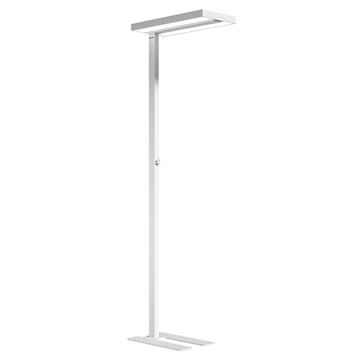
The Honeywell 02E Series Floor Lamp illustrates what these four criteria look like when applied to a real product.
Its design language is strictly rectangular and neutral: a large upward-and-downward emitting panel on a clean vertical pole with a matte white finish. There is nothing in its form vocabulary tied to a particular trend cycle. It would not look out of place in a home photographed in 2015 or designed in 2030.
Structurally, the 02E weighs 33.8 lbs and is constructed from aerospace-grade aluminum and steel. The U-shaped base is engineered to accommodate placement near furniture while preventing tipping. The hardware is accessible via included hex key tools, and the product is backed by a 2-year warranty with direct customer support.
The light source — the SUNTURALUX™ chip co-developed with Bridgelux — is an integrated full-spectrum LED engine delivering a fixed 4,000K color temperature, calibrated to approximate the quality of natural daylight as experienced indoors at 10 a.m. Greenwich Mean Time: a reading-friendly, visually clear, non-fatiguing light environment. The output carries a CRI of 98 and a color fidelity score (Rf) above 97 across 99 color samples — meaning colors in your home will render accurately today and ten years from now.
Flicker depth is certified at 0.00%, holding IEEE PAR 1789 and IEC/TR 63158 compliance. Blue light rating is RG0 — the safest classification under IEC/EN 62471.

What True Minimalism Actually Reduces
The popular shorthand for minimalism — fewer possessions — misses the deeper point. What a well-executed minimalist practice actually reduces is decision frequency. Every object you own that performs its function reliably, looks right in its space, and requires no attention is an object that disappears from your mental load. The lamp you bought once and never thought about again is the lamp that has served its purpose completely.
Behavioral economics research — including work published in decision science journals — has documented the real cognitive cost of decision fatigue: the degradation in decision quality that follows a high volume of choices. Applied to home furnishing, this suggests that purchasing durable, permanent objects at the outset is not merely financially efficient; it is mentally efficient. Every replacement cycle avoided is a procurement decision, a disposal decision, and an installation decision that never has to happen.
Replacement cost, in this context, is never just financial. It includes the hours spent researching alternatives, the delivery windows rearranged, the packaging discarded, and the faint cognitive tax of an environment that is always slightly in transition. A floor lamp chosen to last a decade removes all of that from the equation permanently.
The Minimalist Buying Standard, Applied
Choosing a floor lamp worth keeping for 10 years requires four honest answers: Does the design transcend trends? Is the construction built for permanence? Can it be serviced when needed? And will the light source still be available, stable, and high-quality a decade from now?
The lamps that answer yes to all four are, almost by definition, rare. They tend to cost more at the point of purchase and far less over time. They occupy space in your home as settled, resolved objects — not as placeholders for whatever comes next. That permanence, quietly achieved, is the closest thing a piece of furniture can offer to freedom from the cycle of acquisition and disposal.
If you're evaluating floor lamps through this framework, the Honeywell 02E Series represents a grounded starting point: a product whose design, construction, and light source engineering are each oriented toward a long horizon rather than a quick impression.


