


October is the make-or-break month for Online sellers and handmade creators rushing to fulfill Halloween orders. As the sun sets earlier and workdays stretch longer, many crafters find themselves hunched over workbenches under inadequate lighting, unaware that their lamp choice is silently sabotaging their profit margins.
The problem isn't just fatigue—it's physics. Poor lighting creates visual distortions that lead to measurable business losses: color matching errors in fabric selection, misaligned stitching that customers notice immediately, and texture details that disappear under the wrong light spectrum. For sellers operating on thin margins, a single return due to "not as pictured" complaints can wipe out the profit from three successful sales.
Why October Becomes a Precision Crisis for Makers
The seasonal squeeze hits handmade businesses from multiple angles. Daylight hours shrink by approximately 2 hours between early September and late October in most of the US and Europe, forcing crafters to rely entirely on artificial lighting during their most productive evening hours. According to data from Online's seller forums and craft business surveys, order volumes for Halloween-related handmade items typically surge 300-400% in October compared to summer months.
This convergence—maximum output requirements meeting minimum natural light—creates what lighting ergonomics researchers call "task saturation under compromised visual conditions." Makers working 6-8 hour sessions on repetitive fine-motor tasks experience cumulative visual fatigue, where the eye's ability to distinguish subtle color variations and spatial relationships deteriorates progressively throughout the work session.
The human eye's color perception accuracy can decline by up to 30% under improper lighting conditions, according to studies on visual ergonomics in precision work environments. For a seamstress choosing between navy and black thread at 10 PM under a standard 60-watt incandescent bulb, this isn't academic—it's the difference between a five-star review and a return request.
The Real Cost of "Good Enough" Lighting
Most crafters assume that if they can see their work, the lighting is adequate. This false confidence proves expensive. Consider the actual dollar impact:
Scenario: A handmade Halloween costume seller working under standard overhead lighting
- Average item price: $85
- Material and time cost per item: $45
- Net profit per sale: $40
- Return rate due to "color not as expected" or "stitching issues": 8-12% (industry average for handmade apparel ranges from 5-15% according to small business e-commerce data)
- For every 25 items sold, 2-3 returns eliminate $80-120 in profit
- Add return shipping costs ($8-12 per return) and replacement production time (2-4 hours)
- Total profit erosion per month: $200-400 from preventable visual errors alone
The math becomes even more punishing for sellers working with premium materials. A leather worker purchasing full-grain hides at $8-12 per square foot cannot afford to cut a piece 0.25 inches short due to measurement errors caused by inadequate task lighting. That single mistake on a $200 custom bag project transforms a $120 profit into a $30 loss after material replacement.

"Seeing" vs. "Seeing Accurately"—Why Task-Specific Lighting Matters
General room lighting creates visibility. Task lighting creates precision. The distinction matters enormously for detail work.
Standard ceiling fixtures typically provide 300-500 lumens per square meter of ambient illumination—sufficient for navigation and casual activities, but grossly inadequate for work requiring color accuracy and fine detail discrimination. Professional standards for precision handwork, such as sewing and jewelry making, recommend 1,500-2,000 lumens delivered directly to the work surface with a Color Rendering Index (CRI) above 95.
CRI measures how accurately a light source reveals true colors compared to natural daylight. Standard LED bulbs often score 70-80 CRI, meaning they distort color perception significantly. A fabric that appears burgundy under 75 CRI lighting may actually be a distinctly different rust tone that customers will immediately notice when photographing their purchase under natural light.
Three critical factors separate adequate lighting from precision lighting:
Illumination intensity at task level: Light must reach the work surface at sufficient strength. A lamp positioned 4 feet away provides only 25% of the illumination delivered by the same lamp placed 2 feet from the work surface, following the inverse-square law of light physics.
Color rendering accuracy: High-CRI lighting (95+) preserves color fidelity, essential for fabric selection, paint mixing, and any work where shade matching determines professional results.
Adjustability and directional control: Static overhead lighting creates fixed shadows. Articulating task lights allow makers to eliminate shadows and glare by repositioning the light source as work orientation changes.
Product Solutions Mapped to Craft Business Realities
Different handmade workflows require distinct lighting approaches. Floor lamps serve crafters working with large materials on open surfaces, desk lamps support precision work at fixed stations, and hybrid solutions address creators who move between different task types throughout their production process.
For floor-based cutting and large-format assembly work:
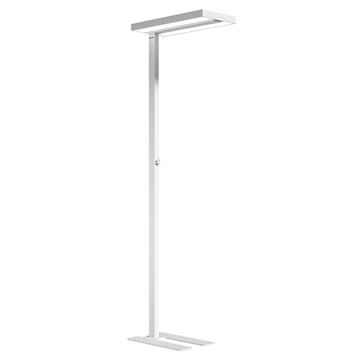
The Honeywell 05D01 floor lamp addresses the specific challenge of illuminating large work surfaces without requiring permanent installation. Pattern cutters working with fabric spreads measuring 6-8 feet long need overhead lighting that doesn't create body shadows across the cutting line. The 05D01's height-adjustable design allows positioning the light source above the maker's shoulder line, eliminating the shadow interference that causes cutting errors costing $15-25 in wasted fabric per mistake.
The gooseneck flexibility proves particularly valuable during the material arrangement phase, when makers need to inspect fabric grain direction and identify flaws before cutting. Repositioning the light at different angles reveals weave irregularities and printing defects invisible under fixed lighting.

For multi-angle desk work and sewing machine operations:
The Honeywell F01 desk lamp serves makers whose work requires frequent viewing angle changes. Sewing machine operators face a specific lighting challenge: the machine head itself blocks overhead light, creating a shadow precisely where needle-and-thread accuracy matters most.
Positioning a multi-articulating lamp on the left side of the machine (for right-handed sewers) and angling the light head to cast illumination past the presser foot solves this problem. The F01's adjustable arm allows this precise positioning while keeping the light source out of the operator's direct sight line, reducing glare fatigue during extended sessions.
For embroidery and detailed hand-sewing, the ability to bring the light source within 12-18 inches of the work surface while adjusting the angle creates the shadow-free illumination field necessary for accurate stitch placement. This proximity lighting reveals thread tension problems immediately, preventing the frustrating experience of completing 20 minutes of stitching only to discover the bobbin tension was incorrect from the start.
For detail work, inspection, and finishing operations:
The Honeywell H4 portable lamp addresses the final-stage quality control work that determines whether an item ships successfully or requires time-consuming corrections. Jewelry makers, miniature crafters, and detail painters need intense, localized lighting for inspection work that reveals flaws before customers do.
The portability factor matters significantly here. A leather worker doing edge finishing can position the lamp to cast raking light across the edge surface, revealing any roughness or unevenness in the burnishing. Moving the light source to different angles exposes different types of surface imperfections—a quality control technique impossible with fixed lighting.
For night-time photography of finished products (essential for next-day listing updates), portable task lighting provides the fill light necessary to eliminate harsh shadows in product photos taken under primary photography lighting, improving the perceived quality of listing images.

The Profit-First Decision Framework
Smart craft business owners evaluate equipment purchases through a return-on-investment lens rather than comfort or convenience metrics. Lighting upgrades justify themselves through reduced error rates and accelerated production speed.
Calculate your lighting ROI:
- Track your current return rate for the next 30 orders
- Identify returns specifically caused by color variance, precision issues, or "not as pictured" complaints
- Calculate profit lost to these preventable returns (item profit + return shipping + replacement production time valued at your hourly rate)
- Compare this monthly loss to the one-time cost of task-appropriate lighting
For most handmade sellers operating at $2,000-5,000 monthly revenue, reducing return rates by just 3-4 percentage points through better lighting produces annual savings of $800-1,500—far exceeding the cost of quality task lighting while simultaneously increasing production capacity through reduced rework time.
Beyond return prevention, proper lighting directly increases production speed. Makers who can accurately see their work the first time eliminate the constant repositioning, double-checking, and hesitation that fragments workflow. A seamstress who confidently places stitches without repeated quality checks completes garments 15-20% faster—effectively adding 6-8 productive hours to every 40-hour work week.
Conclusion: Light as a Profit Center, Not an Expense
The October crunch separates profitable handmade businesses from struggling ones. Sellers who treat their workspace lighting as production equipment rather than room décor gain measurable advantages in precision, speed, and customer satisfaction.
As order volumes surge and daylight disappears, your lighting setup becomes as critical as your sewing machine, cutting mat, or design software. The question isn't whether you can afford task-specific lighting—it's whether you can afford the ongoing profit erosion of working without it.
Every returned item, every re-cut material, every hour spent correcting mistakes that proper lighting would have prevented—these are the real costs of "good enough" illumination. For craft businesses built on precision and reputation, the right lighting isn't a luxury. It's the difference between profitable growth and exhausting survival.


