


As October arrives in North America, daylight savings hasn't yet kicked in, but the psychological shift is already underway. The sun sets earlier, temperatures drop, and suddenly that rigid desk setup feels unnecessarily formal. Many remote workers begin migrating toward their couches, armchairs, or even beds—spaces that feel warmer and more forgiving as the long northern hemisphere nights settle in. But this seasonal behavioral shift carries hidden consequences that most people don't recognize until weeks later: persistent eye strain, disrupted sleep patterns, and a creeping sense of fatigue that no amount of coffee seems to fix.
Why Moving from Desk to Couch in October Becomes a Health Turning Point
The transition from structured desk work to casual couch-based productivity isn't just about comfort—it represents a fundamental change in how your body interacts with light. According to research published in the Journal of Environmental Psychology, postural changes in work settings directly affect visual ergonomics and circadian rhythm stability. When you shift from an upright desk position to a reclined couch posture, your screen typically drops 12 to 18 inches lower, and your neck tilts forward at angles that strain the cervical spine while forcing your eyes to work harder under suboptimal lighting conditions.
October's early sunsets compound this problem. By 6:00 PM, most North American living rooms rely entirely on artificial light, and the typical overhead fixture—designed for ambient illumination rather than task-specific work—creates what lighting engineers call "veiling reflections" on screens. These reflections don't just reduce contrast; they force your pupils to constantly adjust between the bright screen and dimmer surroundings, leading to asthenopia (eye strain) characterized by headaches, blurred vision, and difficulty focusing.
The Double Debt: Eye Fatigue Triggers Brain Arousal, Which Delays Sleep
Here's where the problem escalates beyond mere discomfort. A 2022 study from the Lighting Research & Technology journal found that prolonged visual effort under inadequate task lighting increases cortisol production and delays melatonin onset by an average of 47 minutes. Your eyes aren't just tired—they're signaling your brain to maintain alertness because the visual system interprets poor lighting conditions as a potential threat requiring sustained attention.
This creates what sleep researchers call a "double debt scenario." First, you accumulate visual fatigue throughout the evening as you squint at your laptop from the couch. Second, your circadian system receives conflicting signals: the calendar says it's time to wind down, but your lighting environment—especially if you're compensating with bright overhead lights or cool-toned lamps—tells your brain it's still midday. The result is lying awake at midnight despite feeling exhausted, then waking up groggy because your sleep architecture never properly transitioned through its restorative phases.
Common Nighttime Lighting Mistakes That Worsen the Problem
Most people respond to dim couch-working conditions by simply turning on more lights, but this approach often backfires in three predictable ways:
Over-illumination: Cranking up a ceiling light to 800 lumens or more floods the entire room with brightness that suppresses melatonin production. Research from Harvard Medical School indicates that even moderate exposure to light above 300 lux after 8:00 PM can shift circadian rhythms by 1.5 to 3 hours.
Wrong Color Temperature: Many modern LED bulbs default to 5000K-6500K (cool white/daylight), which mimics midday sun and maximally stimulates the melanopsin receptors in your eyes that regulate your biological clock.
Incorrect Light Direction: Overhead lights create shadows on your work surface and cause glare on screens. What couch workers actually need is vertical task lighting—light that comes from beside or behind them to illuminate the work surface without shining into their eyes or reflecting off screens.
Why Couch and Bed Work Require "Vertical Task Lighting," Not Overhead Ambient Light
The fundamental principle of ergonomic lighting is this: light should come from where the task is, not from where the ceiling happens to be. When you're reclined on a couch or propped up in bed, your work surface—whether a laptop, tablet, or book—occupies a vertical plane relative to your body. Traditional overhead lighting is designed for horizontal surfaces like dining tables or kitchen counters, making it inherently mismatched for the new reality of casual work postures.
Vertical task lighting solves this by positioning the light source beside or slightly behind you, directing illumination onto your screen or reading material at an angle that minimizes glare. Adjustable floor lamps with articulating heads are particularly effective because they allow you to fine-tune both the height and angle as you shift positions throughout the evening. The key specification to look for is a Color Rendering Index (CRI) above 95, which ensures that colors appear natural and reduces the visual effort required to distinguish details.

Product Solutions: Matching Lamp Design to Actual Evening Work Patterns
Not all adjustable lamps are created equal, and the "right" solution depends heavily on your specific setup and habits. Here's how to match lighting tools to real-world scenarios:
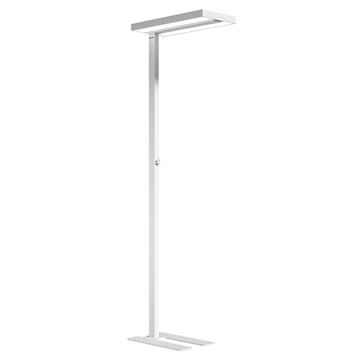
For Deep Reading in an Armchair or Corner Sofa: The 02E Floor Lamp
If your October evenings involve reading reports, books, or long-form articles from a stationary position, you need a lamp that delivers focused downward light without requiring constant repositioning. The 02E extends up to 75 inches in height, allowing you to position the light head directly above your shoulder line for optimal downward illumination. With stepless dimming from 10% to 100% brightness, you can precisely calibrate the intensity to match your page or screen, reducing the pupil dilation fluctuations that contribute to eye fatigue.
The 02E's 4000K natural light output sits in the ideal range for evening task work—bright enough for clear visibility but warm enough to avoid circadian disruption. Its weighted base prevents tipping even when the arm is fully extended, making it particularly suitable for households with pets or children.
For Multi-Tasking Couch Potatoes Who Refuse to Get Up: The F01 Remote Control Floor Lamp
Let's be honest: one of the reasons people migrate to the couch in October is they don't want to maintain desk-like formality. They want to shift seamlessly from work mode to streaming mode to reading mode without getting up. The F01 addresses this reality with a remote control that adjusts both brightness (four levels from 25% to 100%) and color temperature (three settings: 2700K-5700K) from across the room.
This flexibility is crucial for managing circadian health. You might start the evening at 7:00 PM with the 5000K setting for detailed spreadsheet work, then shift to 4000K at 8:30 PM for lighter email tasks, and finally drop to 3000K after 9:00 PM when you're just browsing or reading. The F01's 60-inch maximum height also makes it effective as an ambient uplighter when pointed toward the ceiling, providing gentle background illumination during movie time without creating screen glare.
For Bedside Mini-Desk Setups: The H4 Adjustable Desk Lamp
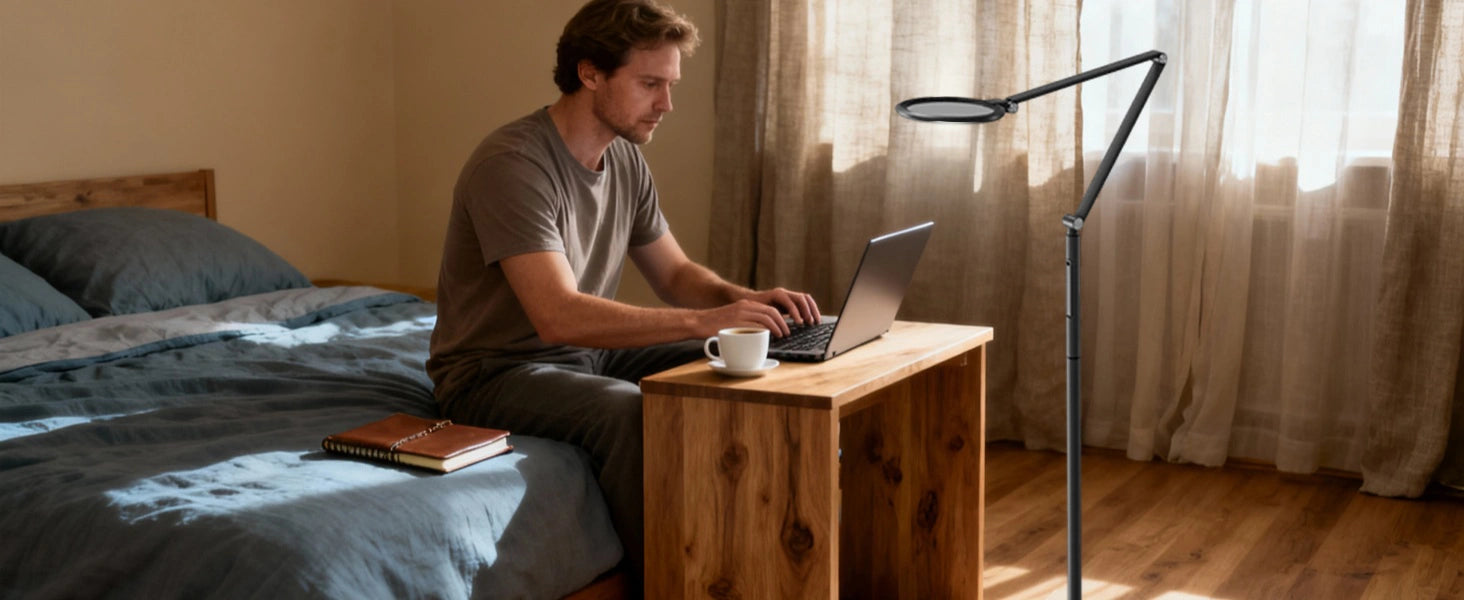
An increasing number of remote workers have abandoned dedicated offices entirely, instead placing a small laptop desk or lap tray at the edge of their bed. This setup offers maximum comfort but creates challenging lighting geometry—you need focused light on a small work surface without flooding the entire bedroom with brightness that would disturb a partner or signal your brain that it's still daytime.
The H4's compact footprint (base diameter under 8 inches) and multi-axis articulation make it ideal for these constrained spaces. Its touch-sensitive dimming panel allows silent brightness adjustment without fumbling for switches or remotes, and the flexible arm rotates through 180 degrees to accommodate reading, typing, or note-taking positions. At maximum output, the H4 delivers 500 lumens concentrated in a focused beam—sufficient for detailed work but contained enough to avoid light pollution beyond your immediate task area.
The Core Principle: Structure Changed, So Lighting Must Change Too
The underlying message isn't that couch work is inherently bad—it's that our lighting infrastructure hasn't evolved as quickly as our work habits have. For decades, residential lighting design assumed that "serious work" happened at desks in dedicated offices, while living rooms and bedrooms were purely recreational spaces needing only ambient illumination. But October 2025 reflects a fundamentally different reality: millions of people now spend 40+ hours per week working from spaces originally designed for relaxation.
According to the American Lighting Association, residential task lighting sales have increased 64% since 2020, but most buyers still gravitate toward designs optimized for traditional desk setups. The next frontier of ergonomic lighting is recognizing that "task" lighting now needs to accommodate reclining postures, variable seating positions, and the circadian sensitivity that comes with working during hours our ancestors would have been preparing for sleep.
October's darkening evenings don't just mark a seasonal transition—they reveal a structural gap between how we live and how we light our lives. Addressing that gap requires more than just buying a lamp; it requires rethinking which light goes where, when brightness matters versus color temperature, and how adjustability becomes non-negotiable when your "workspace" changes position ten times per evening. The couch isn't dangerous. The failure to adapt lighting to couch-based reality is what creates the danger.


