
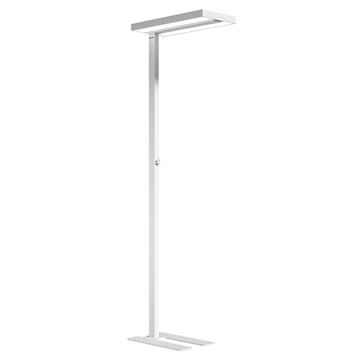


The most overlooked home health risk during October through December isn't dry air or seasonal allergies—it's lighting mismatch. While a single floor lamp might suffice during summer's long daylight hours, Q4's shortened days and task-intensive activities expose a fundamental error: treating all visual work as if it requires the same type of light.
Why "One-Lamp Living" Works in Summer But Fails in Q4
Between June and September, natural daylight extends until 8:00 PM or later across most of North America and Europe. Your single living room lamp functions merely as supplemental lighting—a backup to abundant ambient sunlight. But as October arrives, daylight disappears by 5:30 PM, and that same lamp is suddenly expected to support gift-wrapping, financial year-end reviews, remote work video calls, and late-night reading.
The problem isn't intensity—it's specificity. A 60-watt equivalent LED bulb produces roughly 800 lumens, but when that light source sits 6 feet away and diffuses across an entire room, your close-range tasks receive only 150-200 lux at desk level. The Illuminating Engineering Society recommends 300-500 lux for general reading and 500-1000 lux for detailed tasks like sewing or drafting. Your eyes compensate by dilating pupils wider and engaging ciliary muscles longer—a physiological "overtime shift" that accelerates eye strain.
Light Division Matches Task Division: Reading ≠ Crafting ≠ Screen Work ≠ Circadian Timing
Modern Q4 home life isn't a single activity—it's a task rotation. Between 6:00 PM and 11:00 PM on a typical November weekday, you might cycle through expense spreadsheets (high-contrast screen work), wrapping presents (fine motor coordination), reading holiday cards (reflective paper surfaces), and pre-sleep book reading (relaxation mode). Each requires different photometric characteristics:
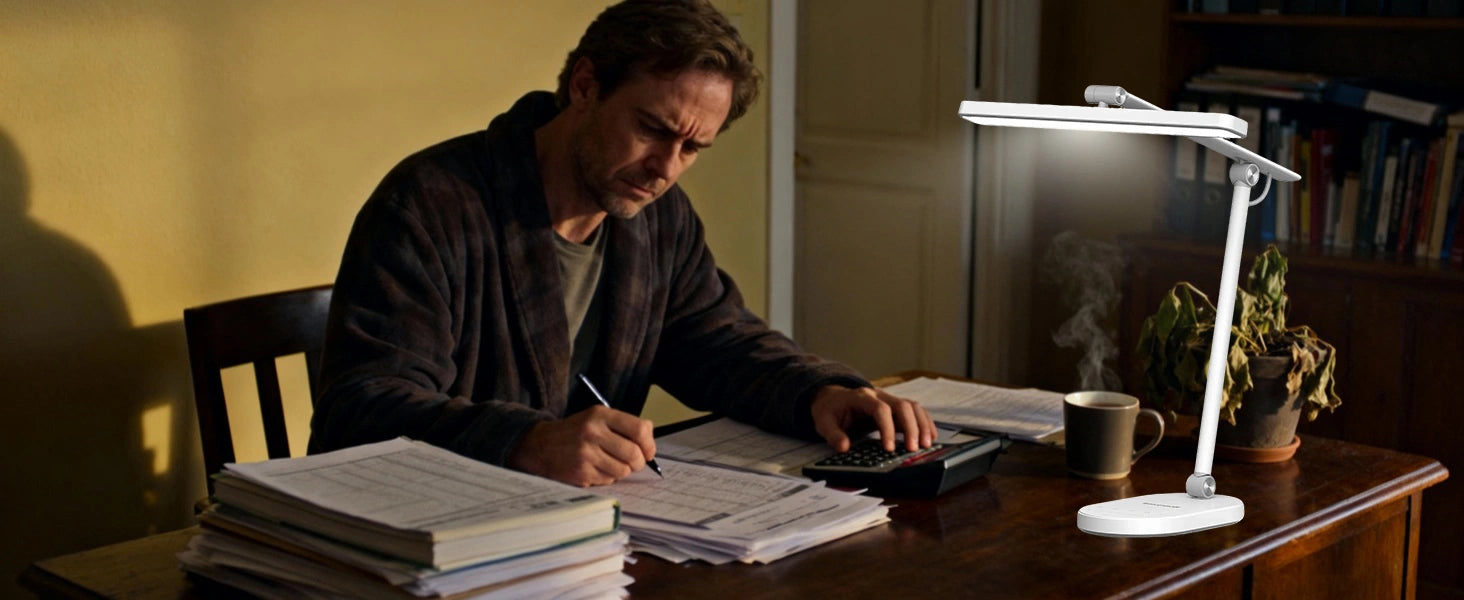
Task lighting for document work demands concentrated, shadow-free illumination at 500+ lux with high Color Rendering Index (CRI 95+) to distinguish between similar ink tones on paper. The Honeywell H4 Intelligent Modern LED Desk Lamp addresses this with stepless dimming and CRI 97 rating—critical when reviewing financial documents or handwritten notes where nuance matters.
Multi-task switching environments need flexible light positioning. When you move from laptop typing (where glare must be eliminated) to hand-sewing a costume (requiring angled side lighting to create depth shadows), a static ceiling fixture forces compromises. The Honeywell 05D01 Artist Daylight Floor Lamp offers mutil-angle rotatable head and memory function—storing your preferred settings for reading mode versus craft mode eliminates the "reset fatigue" of constantly readjusting a single lamp.
Screen-adjacent productivity presents a unique challenge: your monitor already emits 200-300 lux, but surrounding darkness creates excessive contrast ratio that forces constant pupil adjustment. Ambient lighting should be approximately 50% of screen brightness to reduce eye strain. The Honeywell 02E Full Spectrum Eye Caring Floor Lamp with dual-zone lighting allows you to maintain 150-lux ambient glow while directing 500-lux task light onto notebook or keyboard areas—preventing the "tunnel vision" effect of screen-only illumination.
Circadian rhythm management requires the one thing most task lamps ignore: timing-appropriate color temperature. Blue-enriched light (5000K+) suppresses melatonin production, while warmer tones (2700K) signal wind-down time. Using a single cool-white lamp for both afternoon productivity and 10:00 PM reading sends conflicting biological signals. Adjustable color temperature features let you maintain alert 4000K lighting during early evening tasks, then shift to 2700K for pre-sleep reading—supporting natural sleep onset rather than fighting it.
The Real Error: Right Intensity, Wrong Application
Many homeowners respond to Q4 eye strain by simply buying brighter bulbs—upgrading from 60W-equivalent to 100W-equivalent in that single living room fixture. This is like turning up the volume on a podcast when you actually need to switch to an audiobook. Brightness without direction creates new problems:
- Glare amplification: A brighter omnidirectional source increases reflections on screens and glossy surfaces
- Shadow multiplication: Stronger overhead light creates harsher shadows precisely where you need shadow-free visibility
- Energy waste: Illuminating an entire 300-square-foot room to 500 lux consumes 3-4× more power than lighting a 6-square-foot desk area to the same level
Task-specific lighting isn't about adding more light everywhere—it's about placing appropriate light exactly where visual work occurs. A properly positioned desk lamp consuming 8 watts can deliver better visual performance than a 20-watt floor lamp placed across the room.
Why Q4 Specifically Triggers the Crisis
Three converging factors make October-December the critical window:
- Compressed timeline pressure: Year-end financial reviews, holiday preparation, and gift crafting concentrate months of detailed tasks into 8-10 weeks
- Post-daylight timing: Most intensive tasks now occur during full darkness (5:30 PM onward), eliminating natural light's corrective contribution
- Accumulated fatigue: By November, you've already logged 10 months of workload; visual system resilience is depleted precisely when demands peak
A 2019 study in Ophthalmic and Physiological Optics found that reported eye strain symptoms increased 34% during Q4 compared to Q2, with "lighting inadequacy" cited as the primary non-screen-time factor. The seasonal pattern isn't coincidental—it's mechanical.
Habit Redesign: Lighting by Activity Zone, Not by Room Label
The solution isn't buying more lamps randomly—it's matching light type to activity frequency:
Establish a reading zone with directional lighting that eliminates page glare. Position a task lamp 15-18 inches from the book at a 45-degree angle to prevent your head from casting shadows. The 02E's cordless portability means your reading zone can migrate seasonally—the October patio chair becomes the December fireside armchair without rewiring.
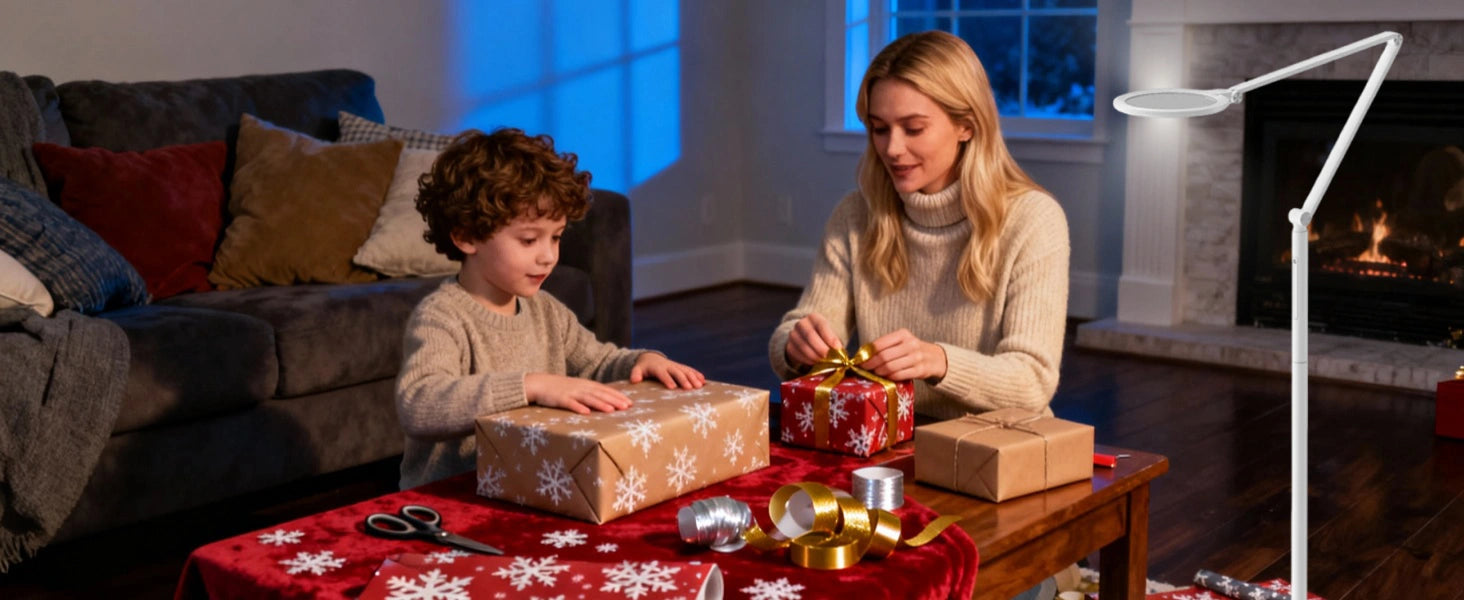
Create a precision-work station for tasks requiring sustained focus: gift wrapping, model building, detailed paperwork. This demands overhead + side lighting to eliminate shadows in 3D work. F01's adjustable height (42-62 inches) and rotatable head let you configure "surgery lighting" for intricate tasks, then collapse to ambient mode for TV watching.
Define a digital workspace that reduces screen-surround contrast. Position your H4 behind and to the side of your monitor, angled to illuminate keyboard and notebook areas without creating monitor reflections. The asymmetric lighting prevents the "headlamp effect" of directly backlit screens while maintaining orientation lighting.
The Outcome: Visual Load Distribution, Not Light Accumulation
By December 31st, the difference isn't that you've used more total light—it's that you've used appropriate light for each task. Your eyes no longer work overtime compensating for mismatch. The chronic squinting stops. Headaches tied to ciliary muscle fatigue diminish. And crucially, your sleep quality improves because you're not flooding your bedroom with 5000K blue light at 10:30 PM while trying to finish a novel.
The one-lamp habit made sense in an era of single-task evenings. But Q4's activity density—and the shortened daylight that reveals its inadequacy—demands a more sophisticated approach. Not more light. Not smarter light. Just correctly assigned light. Task by task. Hour by hour. As deliberately as you'd choose the right knife for each ingredient.


