


Introduction: Shared Needs and Critical Differences Across Craft Disciplines
Every precision hobby—whether you're deciphering fine print in a leather-bound novel, threading a size 10 needle for lace knitting, mixing watercolor glazes, or assembling 1:72 scale aircraft landing gear—imposes three non-negotiable demands on your lighting: adequate illuminance (measured in foot-candles or lux), accurate color rendering (quantified by the Color Rendering Index, CRI), and controlled shadow geometry. Yet the weight each craft assigns to these variables differs dramatically.
Reading typically requires 30–50 foot-candles at the page surface to prevent eye strain during extended sessions, but tolerates moderate color shifts since text contrast matters more than hue fidelity. Knitting and sewing, by contrast, demand CRI values above 90—preferably 95+—to distinguish navy thread from black or chartreuse yarn from lime, while shadow-free fields prevent the needle from vanishing mid-stitch. Fine art painting needs CRI 95+ and balanced illumination to ensure pigments appear as they will under gallery lighting, whereas model making craves pinpoint intensity (100+ foot-candles on a 2-inch work zone) combined with flicker-free output to spare eyes during hours bent over a magnifier.
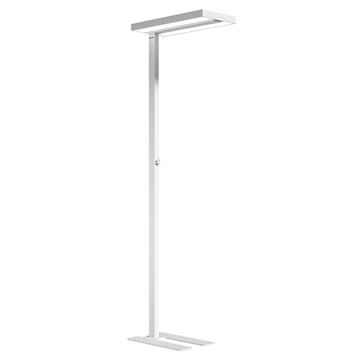
The Honeywell 02E Series Reading Floor Lamp addresses this spectrum with a fixed 4000 K color temperature, an integrated Sunturalux LED chip delivering a verified 98+ CRI, and a stable 6-foot-plus height that places the luminaire above most seated work planes. Its neutral-white spectrum splits the difference between warm incandescent nostalgia and clinical daylight, making it a versatile anchor light. Below we detail how to position, supplement, and optimize the 02E for four common precision hobbies.
Reading: Optimal Illuminance, Lamp Placement, and Material Angle
Recommended Illuminance and Distance
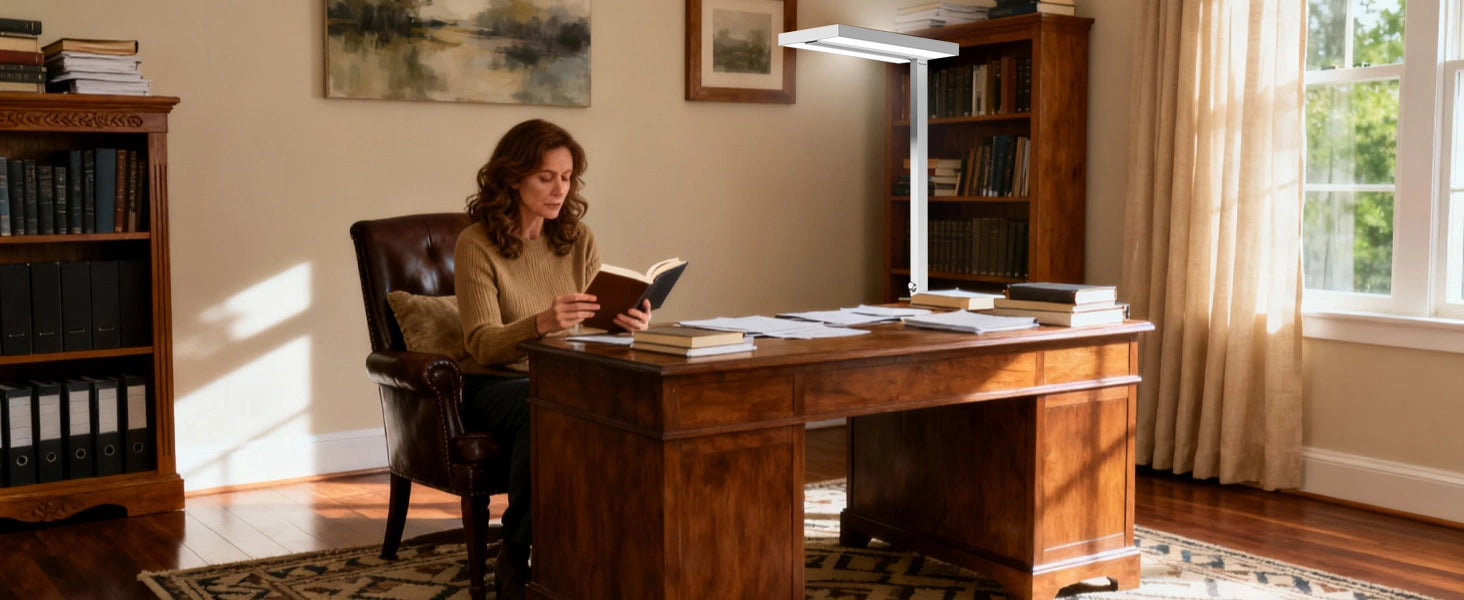
For sustained reading—novels, technical manuals, or sheet music—target 40–50 foot-candles (430–540 lux) at the page surface. Position the 02E's luminaire 18–24 inches laterally offset from your reading material and roughly 12–16 inches above the plane of the book or tablet to minimize glare on glossy paper while flooding the text uniformly.
Placement Strategy
- Over-the-shoulder configuration: If you read in an armchair, place the lamp behind and to the side of your dominant shoulder (right shoulder for right-handed readers). This angles the beam across the page at roughly 45 degrees, reducing specular reflections.
- Adjusting for recliners: When reclining, tilt the book slightly toward the lamp to maintain the incident angle and prevent shadows from your own hand obscuring lines.
- Supplemental task light: For footnote-heavy academic texts or sheet music with tiny annotations, pair the 02E with a small articulated desk lamp aimed at the bottom third of the page, creating a gradient that eases eye transitions.
Material Considerations
Glossy magazines and coated paper reflect more light than matte paperbacks; reduce the 02E's output or increase its distance by 6 inches if you notice a hot spot. Conversely, aging or yellowed pages absorb more light—move the lamp 4–6 inches closer to restore perceived brightness without exceeding comfortable levels.
Knitting & Sewing: Shadow Elimination and Thread-Color Discrimination
Why High CRI Matters
Textile crafts depend on subtle hue distinctions—differentiating between adjacent color families on a Pantone card or matching embroidery floss to a printed pattern. The 02E's 98+ CRI ensures that a skein labeled "dusty rose" won't masquerade as "mauve" under your lamp, a common failure of 80-CRI LEDs or compact fluorescents.
Shadow-Free Field Setup
Single-source shadows occur when the lamp, your hands, and the work surface form a straight line. Break this geometry by:
- Dual-light technique: Position the 02E directly overhead (or slightly forward) and add a secondary LED strip or small floor lamp on the opposite side of your lap or sewing table. The two sources create overlapping penumbras that fill each other's shadows.
- Reflective backdrop: Drape a white or cream fleece blanket over the back of your chair to bounce 15–20 percent of the 02E's output back onto your lap, softening shadows cast by your forearms.
Recommended Illuminance
Aim for 75–100 foot-candles on your lap or sewing-machine bed—higher than reading because thread and fabric surfaces are often less reflective and because precision tasks (threading needles, counting stitches) demand greater contrast. Measure with a light meter app (available free for smartphones) or use the rule of thumb: if you squint or lean forward instinctively, add 25 percent more light.
Practical Tip for Colorwork Knitters
Keep a white index card beside your pattern. Hold yarn samples against it under the 02E; colors that look identical on the card will look identical in your finished piece, regardless of ambient lighting during the day.

Painting: High-CRI Imperatives and Balancing Even vs. Focused Illumination
The Color-Accuracy Imperative
Professional artists and art conservators rely on D50 or D65 standard illuminants (5000 K or 6500 K) to evaluate artwork, but 4000 K neutral white remains acceptable for studio work when paired with CRI above 95. The 02E's 98+ CRI reveals the true chroma of cadmium yellow, the undertones in burnt umber, and the temperature shift between titanium white and zinc white—differences invisible under low-CRI bulbs.
Uniform vs. Spotlight: Choosing Your Strategy
- Uniform field (watercolor, large canvas): Position the 02E 5–6 feet from the easel. Add two smaller LED panels on tripods flanking the canvas at 45-degree angles to eliminate central shadows. Total illuminance should reach 100–150 foot-candles across the entire painting surface, verified by sweeping a lux meter in a grid pattern.
- Focused beam (detail work, miniatures): Bring the 02E within 3–4 feet and aim it at the active 12×12-inch zone. Accept a gradual falloff toward the canvas edges—it naturally directs your attention to the area under your brush and reduces distractions.
Avoiding Metameric Failure
Metamerism—the phenomenon where two colors match under one light source but diverge under another—plagues artists who mix pigments under one lamp and exhibit under gallery halogens. While no single fixture eliminates metamerism, the 02E's broad spectrum and high CRI minimize mismatches. Verification step: Once a painting section dries, photograph it under the 02E and again under noon daylight through a north-facing window; if colors shift drastically, your mix may be metamer-prone.
Heat Consideration
The 02E generates minimal radiant heat compared to incandescent or halogen lamps, preventing acrylic and oil paints from skinning prematurely or warping watercolor paper. For encaustic (wax-based) painting, maintain the lamp at least 4 feet away to avoid unintended melting.
Model Making & Micro-Assembly: Pinpoint Intensity, Magnification, and Flicker-Free Operation
The Case for High Local Illuminance
Assembling 1:48 scale cockpit dashboards, hand-painting 28 mm tabletop miniatures, or soldering surface-mount components demands 150–200 foot-candles on a work zone often smaller than a credit card. Position the 02E directly overhead your bench, supplemented by a flexible gooseneck LED task light aimed at a 60-degree angle from the side—creating a "cross-lighting" setup that reveals three-dimensionality and casts crisp, informative shadows from rivets and panel lines.
Magnification Compatibility
Flicker—rapid, imperceptible fluctuations in light output—causes eye fatigue and headaches, especially when magnification (loupes, Optivisors, or microscope eyepieces) amplifies stroboscopic effects. The 02E's LED driver operates at a sufficiently high frequency to produce flicker-free output under magnification up to 10×, verified by the "smartphone camera test" (point your phone's camera at the lamp; if the screen shows rolling bands, flicker is present).
Appendix: Accessories, Complementary Light Sources, and Maintenance Essentials
Recommended Accessories
- Light meter: Lux/foot-candle meters cost under $20 and eliminate guesswork. Alternatively, smartphone apps like "Light Meter" offer ±10 percent accuracy—sufficient for hobbyist use.
- Reflectors and diffusers: A $5 automotive windshield sunshade (white side inward) makes an excellent 5-foot reflector for painters. For diffusion, theatre lighting gel sheets clip onto lamp shades with clothespins.
Maintenance and Cleaning
- Monthly dusting: Turn off the lamp and wipe the outer shade with a microfiber cloth. Dust on the LED array reduces output by up to 15 percent over six months.
- Annual deep clean: Remove the shade (if detachable) and gently vacuum the heat-sink fins at the bulb's base using a soft brush attachment. Blocked fins can shorten LED lifespan.
- Cord inspection: Check the power cord for fraying near the plug or lamp base every three months—replace if damaged to prevent electrical hazards.
- LED longevity: The 02E's Sunturalux chip is rated for 50,000+ hours. At 4 hours/day, expect 34+ years of service before luminous output drops below 70 percent (the L70 threshold). No bulb replacement is needed during normal lifetimes.
When to Add a Second 02E Unit
If you routinely work across a large surface (a quilter's cutting table, a 72-inch painting easel, or a dual-monitor hobby-streaming setup), two 02E lamps spaced 8–10 feet apart eliminate the "dead zone" between single-source shadows. Creating a uniformly lit 10×6-foot workspace.
Conclusion: One Lamp, Endless Configurations
The Honeywell 02E's fixed 4000 K color temperature, 98+ CRI Sunturalux LED, and 6-foot height provide a stable foundation for precision hobbies, but mastering its output requires understanding your craft's unique demands. Readers need moderate, glare-free illumination; knitters and sewists benefit from shadow-killing dual-light setups; painters must verify color accuracy across the canvas; and model makers crave surgical intensity in a thumbnail-sized zone. By measuring illuminance, controlling shadow geometry, and pairing the 02E with task-specific supplements, you transform a general-purpose floor lamp into a bespoke optical tool. Whether you're threading a needle by lamplight at midnight, mixing the perfect cerulean for a seascape, or cementing a 2 mm photoetched part onto a tank turret, the 02E stands ready—once you've tailored it to your task.
Explore the Honeywell 02E Series: Official site


