
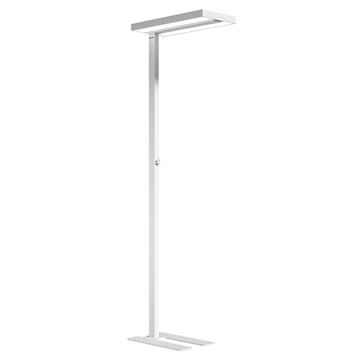


Why Spring Lighting Matters in Small Spaces
As daylight hours stretch longer each spring, many urban dwellers in compact apartments face a paradox: despite more natural light available outside, their interiors remain shadowy and cramped. According to data, approximately 44 million Americans live in rental housing, with studio and one-bedroom apartments accounting for a significant portion of urban dwelling units. These small spaces—often ranging from 400 to 700 square feet—present unique lighting challenges that traditional overhead fixtures simply cannot solve.
Spring represents a psychological fresh start, a season when we instinctively want to refresh our living environments. However, renters face strict limitations: no rewiring, no permanent installations, and no structural modifications. This is where strategic lighting becomes the most cost-effective and renter-friendly solution for transforming how a space feels. Research from the Lighting Research Center at Rensselaer Polytechnic Institute demonstrates that proper lighting can alter perceived room dimensions by up to 20%, making strategic light placement far more than an aesthetic choice—it's an architectural illusion.
The Science Behind Making Small Rooms Look Larger
The secret to creating spacious-feeling interiors lies not in the quantity of light, but in its distribution and direction. Small apartments typically suffer from concentrated lighting that creates harsh shadows and emphasizes cramped dimensions.
Upward lighting—particularly from torchiere-style floor lamps—exploits ceiling surfaces as reflective planes. When light bounces off a white or light-colored ceiling, it diffuses evenly throughout the room, eliminating the tunnel-vision effect created by table lamps and downward-facing fixtures. This technique, known as indirect or ambient lighting, reduces visual clutter by minimizing visible bulbs and harsh light cones while maximizing the perception of height.
The phenomenon works through contrast manipulation. Dark ceilings and upper wall sections make rooms feel lower and smaller. By washing these surfaces with soft, reflected light, you essentially "erase" visual boundaries, allowing eyes to perceive more expansive dimensions. A study published in the Journal of Environmental Psychology found that rooms with ceiling-directed lighting were consistently rated as feeling 15-25% larger than identically sized rooms with conventional downward lighting.
Layered Lighting: The Foundation of Flexible Small-Space Design
Professional interior designers universally recommend a three-layer lighting approach, which proves especially valuable in apartments where single overhead fixtures dominate. These layers include:
Ambient lighting provides overall illumination without harsh shadows. In small spaces, this should come from indirect sources—upward-casting floor lamps or wall-reflected light rather than central ceiling fixtures that create a clinical atmosphere.
Task lighting addresses specific activities like reading, cooking, or working. Adjustable elements are crucial here, particularly for renters who may need to reconfigure spaces as their needs change.
Accent lighting adds depth and visual interest, preventing the flat, monotonous appearance that makes small rooms feel even smaller. This might include highlighting a plant, artwork, or architectural feature to create focal points that guide the eye.
The beauty of this layered approach for renters is its complete portability—every element can move with you, unlike built-in lighting systems. According to the National Multifamily Housing Council, the average renter moves every two years, making investment in portable, multi-functional lighting both practical and economical.
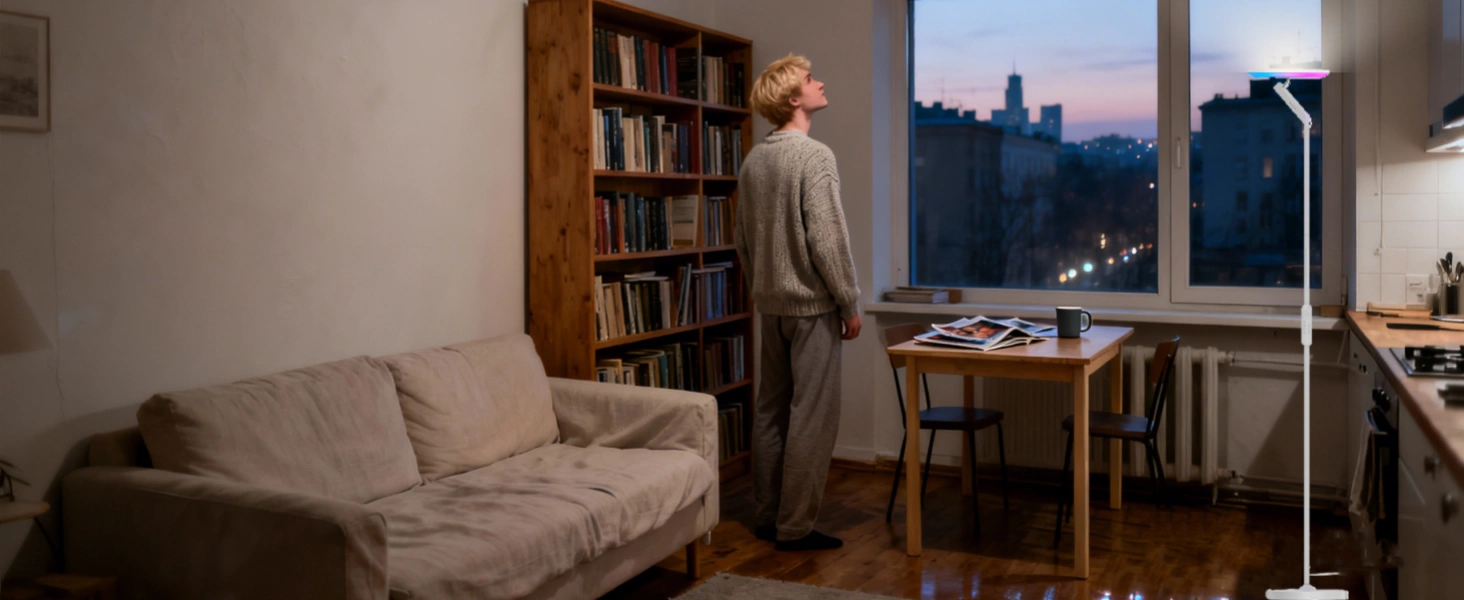
Why Floor Lamps Outperform Other Options in Compact Rentals
Floor lamps offer unmatched advantages for small apartment dwellers. Unlike table lamps, they don't consume precious surface area on desks or nightstands. Unlike pendant lights or sconces, they require no installation or landlord approval. And unlike standing torchieres of previous decades, modern designs incorporate smart technology and adjustable features that serve multiple purposes.
The Honeywell SmartLighting F2 floor lamp exemplifies this evolution in renter-friendly lighting design. Standing at approximately 5 feet tall with a compact 10-inch diameter base, it occupies minimal floor space while providing both upward ambient lighting and adjustable downward reading light. This dual-direction capability addresses the layered lighting principle in a single, portable unit—eliminating the need for multiple fixtures that would clutter limited space.
The torchiere-style upward light component washes ceilings with soft, diffused illumination that makes standard 8-foot ceilings appear higher. Meanwhile, the adjustable reading arm provides focused task lighting without requiring a separate lamp and table arrangement. For a studio apartment resident working from a small desk by day and reading on a sofa by evening, this multi-functionality transforms one piece into an entire lighting system.
Smart controls add another dimension of space optimization. Through app-based dimming and color temperature adjustment (ranging from warm 2700K for evening relaxation to cool 5000K for productive mornings), a single fixture adapts to different times of day and activities. This eliminates the need for multiple specialized lamps, reducing both visual clutter and the "lamp fatigue" that occurs when every surface holds a separate light source.
Spring-Specific Lighting Strategies for Apartment Dwellers
Spring's extended daylight creates specific challenges for small apartments. Morning sun may flood east-facing windows while leaving interior spaces shadowy. Late afternoon light can be harsh and directional, creating uncomfortable glare. Evening still arrives relatively early, requiring artificial lighting for several hours.
Balance natural light variations by positioning upward-casting floor lamps in interior corners farthest from windows. This creates consistent baseline illumination that supplements—rather than competes with—changing natural light throughout the day. According to the American Society of Interior Designers, corners are particularly critical in small spaces because they're typically under-lit, creating the visual "shrinkage" that makes rooms feel cramped.
Utilize warm color temperatures (2700-3000K) during evening hours to create continuity with spring's golden-hour light quality. Cool temperatures (4000-5000K) work better during overcast days or early mornings when you need alertness and energy. Smart fixtures that allow temperature adjustment throughout the day support natural circadian rhythms while maintaining visual comfort.
Maximize vertical space perception by ensuring at least one light source in each room directs upward. Research from the Illuminating Engineering Society indicates that rooms with predominantly downward lighting lose approximately 30% of perceived height compared to those incorporating upward components.
Practical Implementation: Room-by-Room Approach
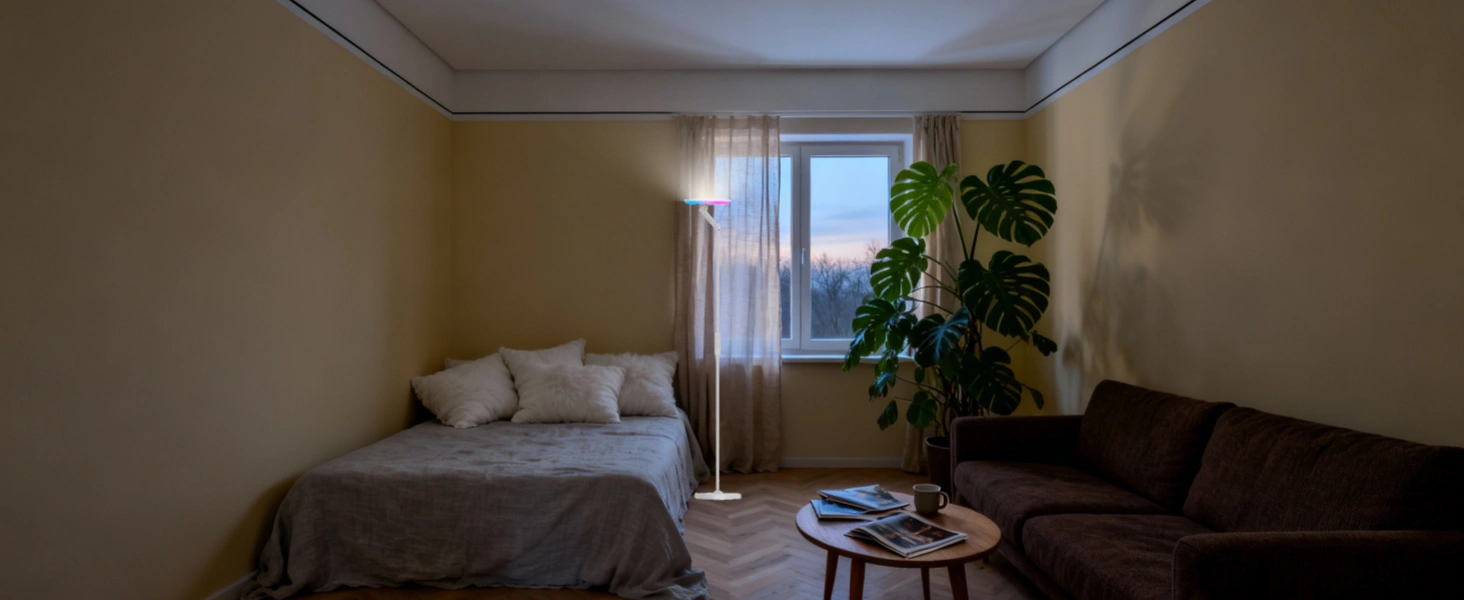
Living areas benefit most from corner placement of torchiere-style lamps. Position your primary ambient source diagonally across from your seating area to eliminate the "spotlight effect" while maintaining even illumination. If your apartment combines living and sleeping areas, a dimmable floor lamp allows one fixture to serve both relaxed evening entertainment and functional daytime needs.
Work zones require flexibility that multi-arm floor lamps provide perfectly. The Honeywell F2's adjustable reading light can reposition from desk-side during work hours to chair-side for evening reading, all while the upward ambient component maintains consistent background lighting. This adaptability is especially valuable for the millions of Americans who adopted remote work during the pandemic and continue working from apartments not designed as offices.
Bedroom spaces in studio apartments need lighting that transitions between functional morning routines and calming evening wind-down. A floor lamp positioned behind or beside the bed provides both task lighting for reading and soft ambient light for nighttime navigation—replacing the need for separate nightstand lamps, overhead fixtures, and pathway lighting.
Long-Term Benefits Beyond Aesthetics
Strategic lighting investment pays dividends beyond immediate visual improvement. Quality floor lamps with LED technology, like those in the Honeywell SmartLighting range, typically consume 80-90% less energy than traditional incandescent fixtures while lasting 15-25 times longer. For budget-conscious renters, this translates to minimal electricity costs and no bulb replacement hassles for years.
The portability factor cannot be overstated. According to research , renters move an average of 11 times during their lifetimes. A well-designed floor lamp moves effortlessly between locations, maintaining consistent quality of life regardless of apartment size or layout. This contrasts sharply with built-in solutions or furniture-integrated lighting that must be abandoned with each move.
Finally, proper lighting demonstrably affects mental health and productivity. The National Institute of Mental Health notes that inadequate lighting contributes to seasonal mood disruptions, while research published in the Journal of Clinical Sleep Medicine links poor evening lighting to disrupted sleep patterns. For apartment dwellers spending significant time in compact spaces, optimizing light quality is an investment in wellbeing, not just decoration.
Conclusion: Small Changes, Significant Impact
Transforming a small apartment's atmosphere doesn't require construction permits, landlord negotiations, or expensive renovations. Strategic lighting—particularly upward-casting, multi-functional floor lamps—offers renters immediate, portable, and reversible improvements that make compact spaces feel genuinely larger and more comfortable.
This spring, as natural light shifts and our instinct to refresh our environments awakens, consider how light distribution rather than light quantity can redefine your living space. A single well-placed torchiere-style lamp like the Honeywell SmartLighting F2 can replace multiple fixtures, reduce visual clutter, and create the layered, flexible illumination that makes small apartments feel like home rather than temporary way stations.
The most effective small-space solutions aren't about buying more—they're about choosing better. When each piece serves multiple purposes and adapts to changing needs, even the most compact apartment can feel spacious, bright, and distinctly yours.


