


Spring is more than a season — for many knowledge workers, it signals a mental reset. Programmers revisit abandoned projects, writers return to unfinished manuscripts, and researchers pick up threads set aside in the darker months. Yet achieving deep focus requires more than good intentions. According to cognitive science research published in a leading environmental psychology journal, the quality of ambient light in a workspace directly affects attention regulation, working memory, and the ability to sustain a single cognitive task for extended periods. If you're serious about productivity this spring, your lighting deserves as much thought as your task management system.
What Is "Deep Work Lighting" — and Why It Differs From Mood Lighting
The concept of deep work, popularized by productivity researchers, refers to cognitively demanding tasks performed in a state of distraction-free concentration. Deep work lighting, then, is not about atmosphere or aesthetics. It's about engineering a visual environment that actively supports your brain's ability to lock in.
Most decorative floor lamps and bias lighting setups are optimized for warmth and ambiance — low color temperatures around 2,700K to 3,000K that feel comfortable but signal the brain toward rest. For sessions of intense focus, however, environmental researchers at a major European university found that neutral daylight-balanced illumination — typically around 4,000K — is associated with improved alertness and reduced cognitive fatigue compared to warmer indoor sources.
The key distinction: mood light decorates your space; functional light equips your mind. Reducing visual contrast, eliminating harsh shadows, and bathing your workspace in even, neutral illumination are the building blocks of a genuine flow state lighting setup for a home office.
Four Core Metrics of a Truly Functional Lighting Setup
Before evaluating any floor lamp for a deep work environment, it helps to understand the four functional benchmarks that actually matter:
1. Light Stability. Flicker — even at frequencies invisible to the naked eye — has been documented to increase visual fatigue and cognitive load. A lamp with 0.00% flicker depth, verified against IEEE PAR 1789 standards, delivers the kind of electrically stable output that won't quietly drain your attention over a three-hour work session.
2. Light Uniformity. A narrow directional lamp creates bright spots and dark zones, forcing your eyes to constantly re-adapt. A broad-panel floor lamp that distributes light both upward (via ceiling bounce) and downward across your desk surface eliminates this re-adaptation cycle, keeping visual effort low.
3. Freedom From Blue-Light Hazard. Not all blue light is harmful — but high-intensity, spectrally unbalanced blue light common in cheap LEDs is classified under Risk Group 1 or 2 for eye safety. A lamp rated RG0 (Risk Group 0) under IEC/EN 62471 certification means the light output poses no measurable photobiological risk, even under extended daily use.
4. Dimming Memory. The ability to return to a preferred brightness level without re-adjusting each session eliminates micro-friction from your work ritual. For deep workers who are protective of their cognitive startup routines, this single feature matters more than it sounds.
How the Honeywell SmartLighting 02E Addresses Each of These Needs
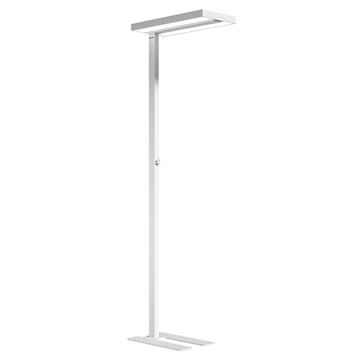
The Honeywell SmartLighting 02E floor lamp is purpose-built around the philosophy that a lamp should function as a cognitive tool, not just a light source. Here is how it maps against the four criteria above:
The 02E series is powered by the proprietary SUNTURALUX™ chip, co-developed with Bridgelux, which produces a full-spectrum output calibrated to a fixed 4,000K color temperature — engineered to replicate the quality of natural daylight at approximately 10:00 AM Greenwich Mean Time. This is not a tuneable or warm-shift light; it is a stable, consistent daylight environment that gives indoor workers access to the visual conditions most closely associated with midmorning cognitive clarity.
Its OPTIKPROCESSOR™ driver system maintains a flicker depth of 0.00%, certified under both IEEE PAR 1789 and IEC/TR 63158, eliminating one of the most underappreciated sources of eye strain in home office setups. The lamp also holds a blue-light hazard rating of RG0 under IEC/TR 62778 and IEC/EN 62471 — the lowest possible risk classification — and has been independently tested and certified by TÜV Rheinland in Germany.
For light distribution, the 02E uses a large rectangular panel combining upward and downward emission, bouncing light off the ceiling via diffuse reflection while simultaneously projecting downward through a high-density micro-prism crystal panel. The result is a workspace illuminated across up to 258 square feet with minimal shadows and near-zero glare — exactly what a minimal floor lamp for focused work should deliver. The color rendering index exceeds CRI 98, with a color fidelity score of Rf > 97 across 99 color samples, meaning your screen, your notebook, and everything in your visual field are rendered with near-perfect accuracy.
A single rotary knob controls dimming from 10% to 100% with precise mechanical damping, and the lamp retains your last-used brightness setting — so your flow state lighting setup for a home office begins exactly where you left it.
Constructed from aerospace-grade aluminum and steel, the 02E weighs 33.8 lbs — substantial enough to stay planted even in active home office environments — and the U-shaped anti-tip base is engineered for stability around desk furniture.
Building Your Deep Work Lighting System This Spring
The 02E doesn't require a complicated setup. Here are three practical principles for integrating it into a productive spring workspace:
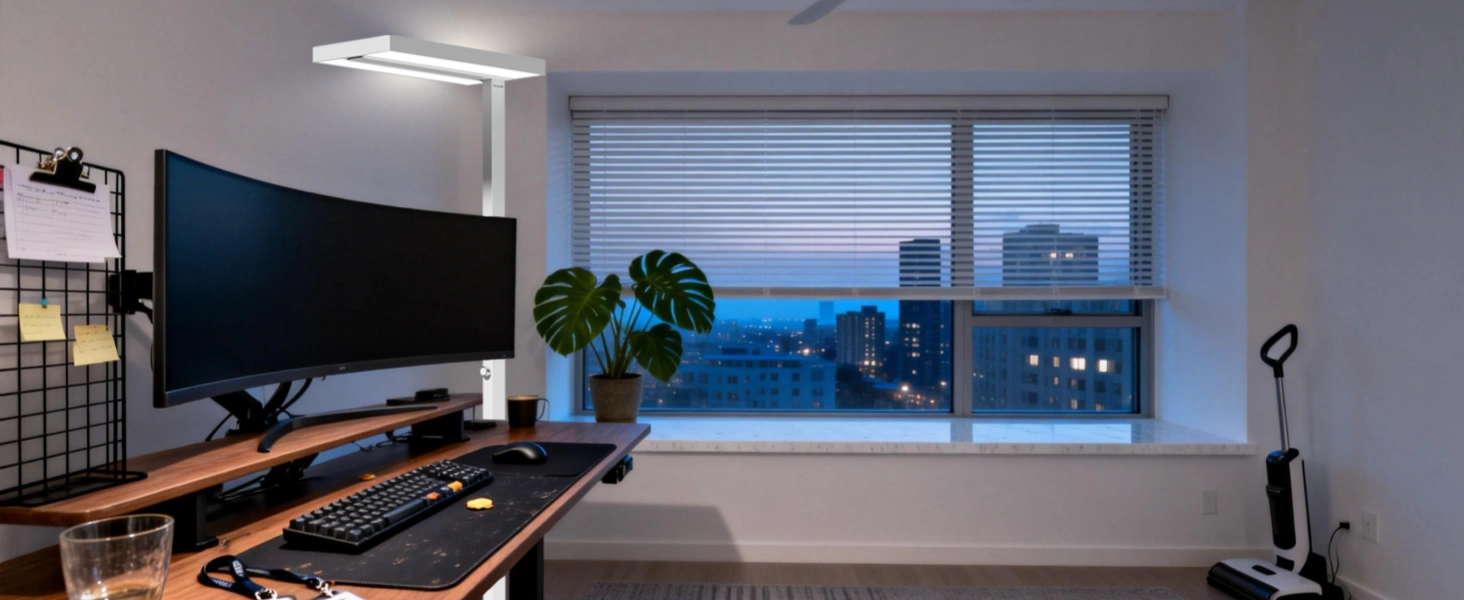
Position the lamp to your non-dominant side, approximately 4 to 5 feet from your primary work surface, so the panel faces toward your workspace without casting direct light into your eyes. The upward diffusion component will wash the entire room in even ambient light, removing the high-contrast shadows that cause visual fatigue during long reading or coding sessions.
Keep overhead lighting minimal or off while the 02E is running. Layered artificial light sources with inconsistent color temperatures create visual noise that your brain must continuously filter out. A single, consistent, well-diffused source is almost always better than multiple conflicting ones.
Use the dimming range intentionally: start deep work sessions at 70–100% brightness to support alertness, and step down to 40–60% during review or lower-intensity tasks. This aligns with research on illuminance and task performance suggesting that higher light levels favor the executive function tasks most central to deep work.
Conclusion: The Right Light Is an Infrastructure Decision
Choosing a lamp for a deep work space is not a style decision — it's an infrastructure decision. The wrong light doesn't just look bad; it actively degrades the cognitive conditions you need to do your best thinking. A stable, uniform, full-spectrum source like the Honeywell 02E doesn't just brighten a room. It removes one of the most overlooked sources of friction from your focus environment — and in spring, when your momentum is ready to build, that margin is worth protecting.
Explore the Honeywell SmartLighting 02E series: https://honeywellsmartlighting.com/products/02e


