


As autumn transitions into winter across North America and Europe, daylight hours shrink dramatically—from approximately 14 hours in September to barely 9 hours by late December in northern latitudes. This seasonal shift forces millions of people indoors earlier, where they continue reading, crafting, and working under artificial lighting that often falls short of their visual needs. According to research published in the Journal of Environmental Psychology, inadequate task lighting during winter months correlates with a 34% increase in reported eye strain and headaches among remote workers and hobbyists.
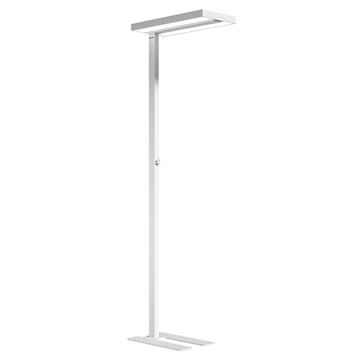
Task lighting—targeted illumination designed for specific activities—becomes critical during these shorter days. Unlike ambient lighting that fills a room, task lighting delivers concentrated brightness exactly where your eyes need it most: on book pages, knitting needles, drawing tablets, or laptop keyboards. This article explores how proper task lighting, exemplified by the Honeywell 02E Series Reading Floor Lamp, addresses the unique challenges of winter indoor activities while protecting visual health.
Why Task Lighting Matters More in Fall and Winter
The National Eye Institute reports that adults over 40 require approximately three times more light to perform detail work comfortably compared to younger individuals. During winter, when natural daylight contributes virtually nothing to indoor illumination after 5 PM, this deficit becomes pronounced. Poor lighting forces your eyes to work harder, leading to:
- Digital eye strain: The American Optometric Association identifies insufficient lighting as a primary contributor to computer vision syndrome, affecting 65% of American adults who work on screens
- Postural compensation: People unconsciously lean closer to work surfaces in dim conditions, creating neck and shoulder tension
- Reduced productivity: Studies from the Lighting Research Center at Rensselaer Polytechnic Institute show task completion times increase by 15-25% under suboptimal lighting
Winter's early darkness also disrupts circadian rhythms. While task lighting cannot replace the full-spectrum benefits of daylight, properly calibrated artificial light between 4000-5000K (neutral white) can help maintain alertness during evening activities without interfering with sleep preparation later.
Understanding the 02E Series: Model Range and Task Matching
The Honeywell 02E Series offers multiple configurations designed for different intensity requirements. Here's how the series breaks down for common tasks:
| Model | Lumen Output | Coverage Area | Ideal Tasks | Recommended Distance |
|---|---|---|---|---|
| 02E-60W | 6,000 lumens | 4-6 sq ft | Casual reading, tablet use | 3-4 feet |
|
02E-80W |
8,000lumens | 8-10 sq ft | Extended reading, light crafts | 4-5 feet |
| 02E-100W | 10,400lumens | 12-15 sq ft | Detailed needlework, painting | 5-6 feet |
| 02E-155W | 16,000 lumens | 18-20 sq ft | Professional drafting, jewelry work | 6-7 feet |
The Illuminating Engineering Society (IES) recommends task lighting deliver between 300-500 lux (lx) at the work surface for general reading, and 750-1000 lx for precision tasks. The 02E series achieves these targets through adjustable height (typically 50-65 inches) and rotatable heads that allow precise beam direction.
Task-Specific Lighting Guidelines
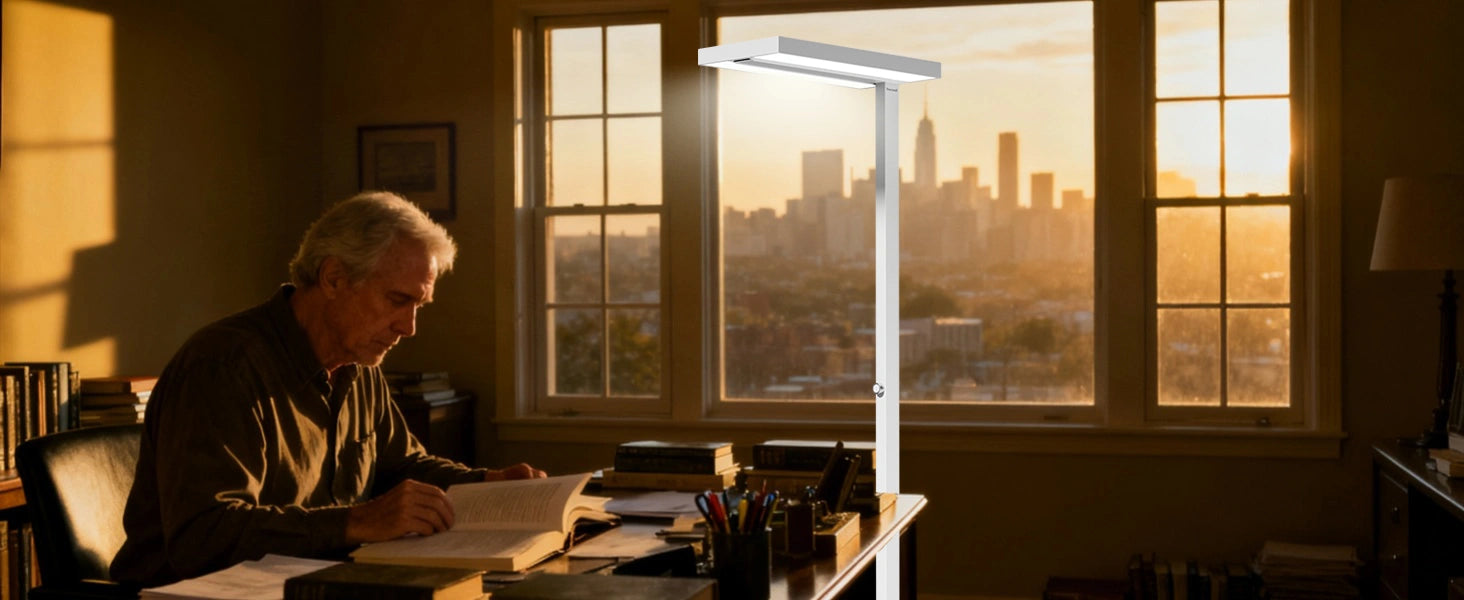
Reading: Books, E-Readers, and Tablets
For comfortable reading, position your 02E lamp to create 400-500 lx at page level. Measure this by placing the light source:
- Angle: 45 degrees off-center from your reading material to minimize glare on glossy pages
- Height: Approximately 15-18 inches above the page surface
- Distance: 24-30 inches from your eyes to the text (standard reading distance)
For seniors: Research from the American Geriatrics Society indicates readers over 65 benefit from 800-1000 lx due to age-related lens yellowing and reduced pupil dilation.The anti-glare diffusion technology in the 02E series prevents the harsh shadows that can make text edges appear blurry—a common complaint among older readers.
Needlework, Knitting, and Crafting
Textile crafts demand consistent lighting across a 12-18 inch work zone. The challenge lies in eliminating shadows from your hands and tools:
- Optimal setup: Use the 02E positioned 36-40 inches from your lap, angled at 60 degrees from vertical
- Shadow reduction: The 02E's multi-directional LED array creates overlapping light cones that minimize hand shadows—critical when threading needles or following complex knitting patterns
- Color accuracy: The 02E series maintains a Color Rendering Index (CRI) above 90, ensuring yarn colors appear true to life (essential for matching skeins or following color-coded charts)
A study by the Craft & Hobby Association found that 78% of crafters over 50 had abandoned intricate projects due to inadequate lighting. The 02E's zoned illumination addresses this by allowing independent adjustment of upper and lower light segments, letting you brighten your handwork while keeping ambient light softer.
Drawing, Painting, and Design Work
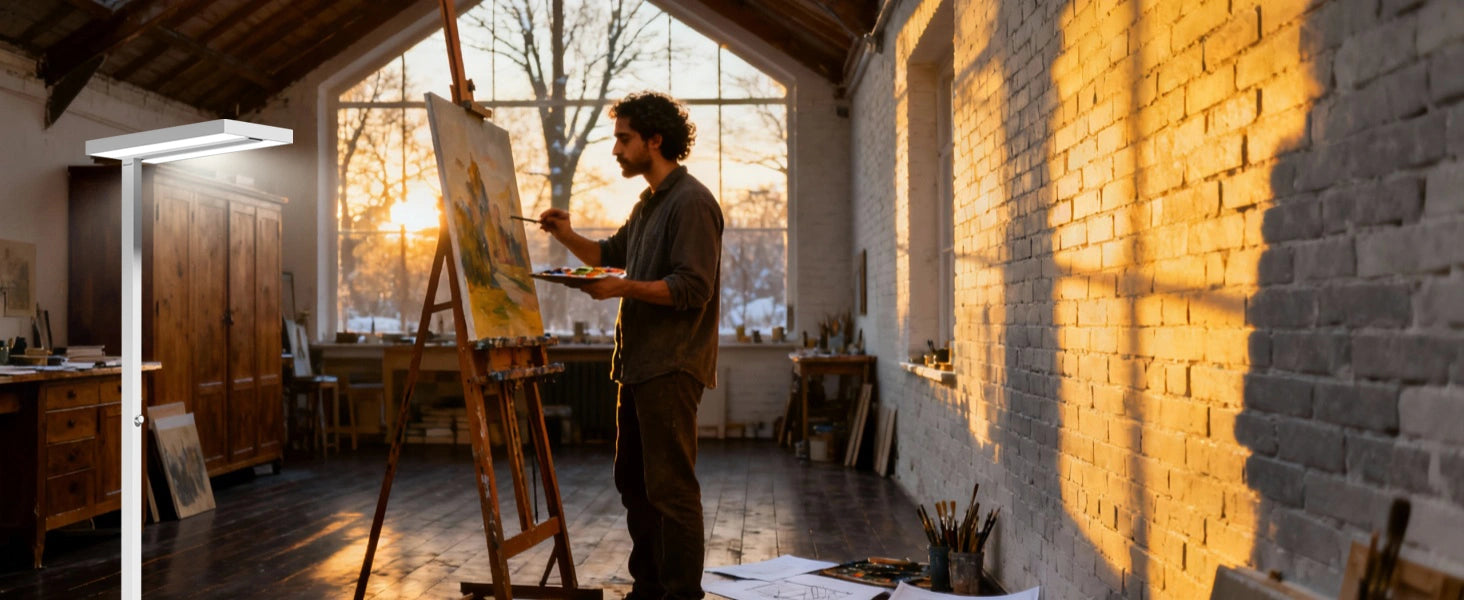
Artists require shadow-free illumination that doesn't distort color perception:
- Placement: Mount the 02E at 48-55 inches height, 40-45 inches from your easel or drawing board
- Cross-lighting technique: For oil painting or detailed pencil work, pair your 02E floor lamp with a secondary desk lamp on the opposite side (approximately 90 degrees apart). This cross-pattern eliminates the single-source shadows that obscure fine details
- Flicker elimination: The 02E's electronic drivers operate at frequencies above 20,000 Hz, preventing the subliminal flicker that can cause headaches during extended drawing sessions
Remote Work and Computer Use
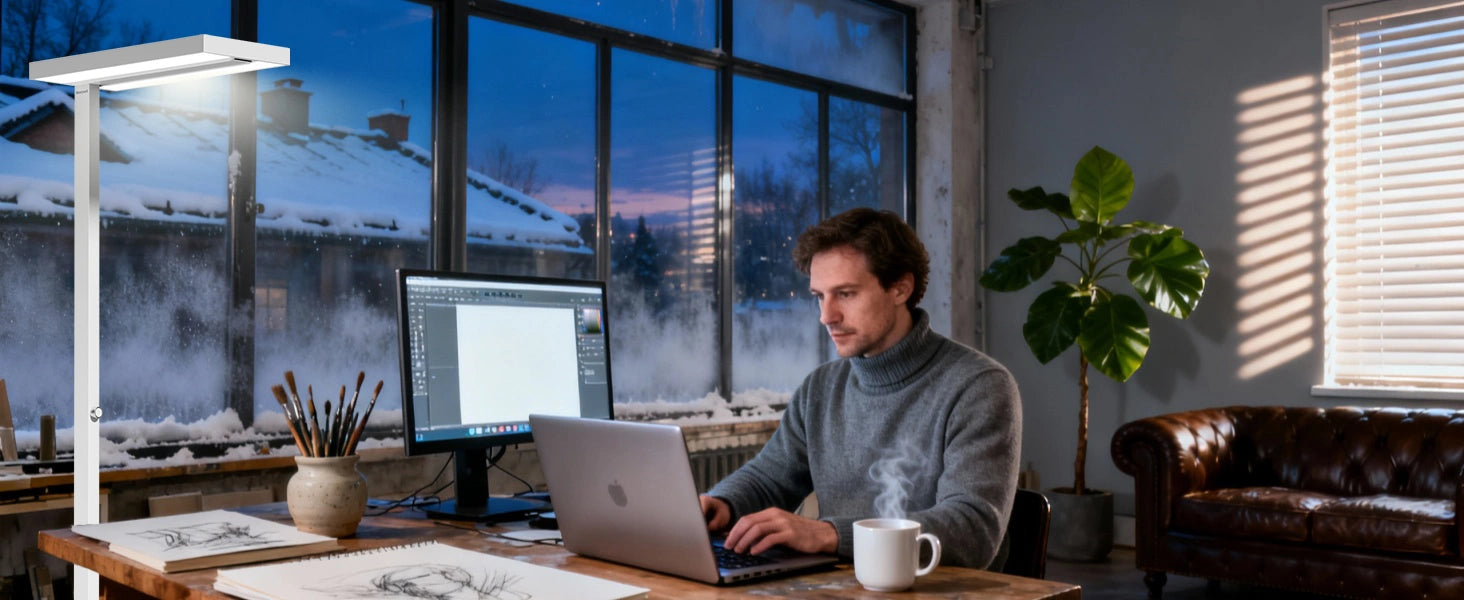
Office tasks combine screen viewing with document reading—requiring balanced lighting that avoids monitor glare:
- Screen positioning: Place your 02E lamp behind and to the side of your monitor, never directly behind you (which creates reflections) or directly in front (which causes pupil constriction)
- Document lighting: If you reference printed materials while typing, angle the 02E's lower segment toward your desk surface to deliver 300-400 lx on papers while maintaining 200-300 lx ambient light
Shadow Control and Multi-Refraction Technology
Traditional single-bulb lamps create hard shadow edges that interfere with precision work. The 02E series employs dual-panel LED arrays with micro-prismatic diffusers—a design that produces what lighting engineers call "soft shadows with defined boundaries."
How it works: Each LED panel contains multiple rows of diodes positioned at slightly offset angles. Light from these sources overlaps at the work surface, creating zones where shadows from your hands or tools become semi-transparent rather than opaque. This is particularly valuable for:
- Jewelry assembly: Seeing both sides of small components simultaneously
- Circuit board soldering: Identifying wire placement without shadow concealment
- Calligraphy and pen work: Observing ink flow without pen barrel shadows obscuring your view
Age-Appropriate Lighting Adjustments
Children (Ages 6-12)
Younger eyes require less absolute brightness but benefit from even distribution to prevent localized fatigue:
- Homework stations: 300-400 lx from the 02E-60W, positioned 30 inches away
- Reading before bed: Dimmed mode at 150-200 lx to avoid sleep disruption (use timer functions if available)
- Art projects: 500-600 lx with emphasis on color accuracy (CRI >90)
Adults (Ages 25-55)
Standard task lighting recommendations apply, with adjustments for specific conditions:
- Nearsighted individuals: May prefer slightly closer placement (20-22 inches) at lower intensity to reduce accommodation strain
- Astigmatism: Benefit from diffused rather than point-source lighting to minimize visual distortion
Seniors (Ages 65+)
Age-related vision changes demand thoughtful lighting adaptation:
- Increased illumination: 2-3× standard recommendations (800-1000 lx for reading)
- Reduced glare sensitivity: The 02E's anti-glare engineering prevents the halos and starbursts that plague older eyes when exposed to bright point sources
- Contrast enhancement: Position lights to create 20:1 contrast ratios between task surfaces and backgrounds (e.g., dark text on white paper with darker wall behind)
The National Institute on Aging emphasizes that proper task lighting can delay or reduce symptoms of age-related macular degeneration by minimizing oxidative stress on retinal cells caused by excessive accommodation.
Practical Setup for Winter Months
To maximize the 02E series' effectiveness during short-day seasons:
-
Conduct a lux audit: Use a smartphone light meter app (many are free) to measure actual brightness at your work surfaces. Record readings at different times during late afternoon/evening to identify when supplemental lighting becomes necessary.
-
Layer your lighting: Combine the 02E's task illumination with ambient ceiling lights set at 100-150 lx. This 3:1 task-to-ambient ratio prevents harsh contrast that fatigues peripheral vision.
-
Adjust seasonally: As winter solstice approaches, begin using task lighting 30 minutes earlier each week. This gradual shift helps your circadian system adapt to changing daylight patterns.
Conclusion: Investing in Visual Comfort
As winter's short days compress our productive hours into artificially lit evenings, the quality of our task lighting directly impacts both our capability and comfort. The Honeywell 02E Series demonstrates how thoughtful engineering—zoned brightness control, shadow-reducing diffusion, and age-appropriate intensity ranges—addresses the practical challenges readers, crafters, and remote workers face during the darkest months.
Proper task lighting isn't luxury; it's preventive health care for your eyes and a productivity tool that extends your useful working hours without extracting a visual toll. Whether you're a senior seeking clearer book text, a quilter needing shadow-free fabric inspection, or a designer requiring color-accurate illumination, matching lamp specifications to task requirements transforms winter evenings from dimly endured to comfortably productive.


