


Spring is the season city dwellers rethink their spaces. Whether you're in a 350-square-foot studio in Brooklyn, a compact flat in East London, or a Haussmann-era chambre de bonne in Paris, the annual ritual is the same: move a bookshelf here, drag a side table there, order something from the internet, and wonder why the room still feels cramped. The problem, more often than not, isn't the furniture. It's the light.
Interior design research from a European university studying residential wellbeing in dense urban environments has consistently found that perceived spaciousness correlates more strongly with the quality and distribution of light than with actual square footage. In other words, a 400-square-foot apartment with well-designed lighting will feel larger than a 550-square-foot apartment with flat, overhead-only illumination. That insight changes how we should think about spring apartment resets — not as a furniture problem, but as a lighting environment problem.
Why Small Spaces Need Lighting, Not More Furniture
The impulse to buy furniture to solve a small-space problem is understandable. A dedicated reading chair feels like the "right" solution to reading in bad light. A desk lamp signals a work zone. A bedside lamp handles evenings. But each piece of furniture eats floor space, and in a studio or one-bedroom apartment under 600 square feet, every square foot matters.
The smarter approach is to think of light as a spatial flexibility tool — something that defines zones without occupying them. A well-placed floor lamp that casts both upward ambient light and downward task light can serve the same spatial function as three separate fixtures while occupying the footprint of a single lamp base. This is the core logic behind a long-term minimalist apartment strategy, and it's exactly what separates thoughtful lighting design from simply "buying a lamp."
The One-Lamp, Three-Zones Framework
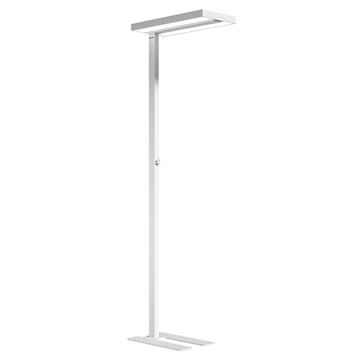
The Honeywell 02E floor lamp was engineered around a dual-direction light architecture: a large rectangular panel that simultaneously sends light upward toward the ceiling and downward into the immediate environment. This design isn't accidental — it replicates the way natural light behaves outdoors, where ambient sky light and directional sunlight overlap to eliminate harsh shadows and create a visually comfortable environment.
In practice, this means a single lamp positioned thoughtfully in a studio apartment can serve three distinct functional zones depending on the time of day and the brightness level you dial in:
Zone 1 — Reading & Focus (Daytime): At higher brightness settings (70–100%), the downward-facing panel provides task-level illumination sufficient for sustained reading or detailed work. The lamp's high-density micro-prism diffusion panel — a physical refraction system rather than a simple shade — scatters the light across a wide area, dramatically reducing the eye-fatiguing contrast between bright page and dark surroundings that a standard reading lamp creates.
Zone 2 — Work-From-Home Setup (Mid-Day to Afternoon): The upward component bounces a broad wash of light off the ceiling, creating even ambient fill throughout the room. This ceiling-reflected layer mimics the overcast-sky diffusion that professional photographers prize and that interior designers specify for home office setups, eliminating the harsh shadows that make video calls look unflattering and that make sustained screen work feel tiring.
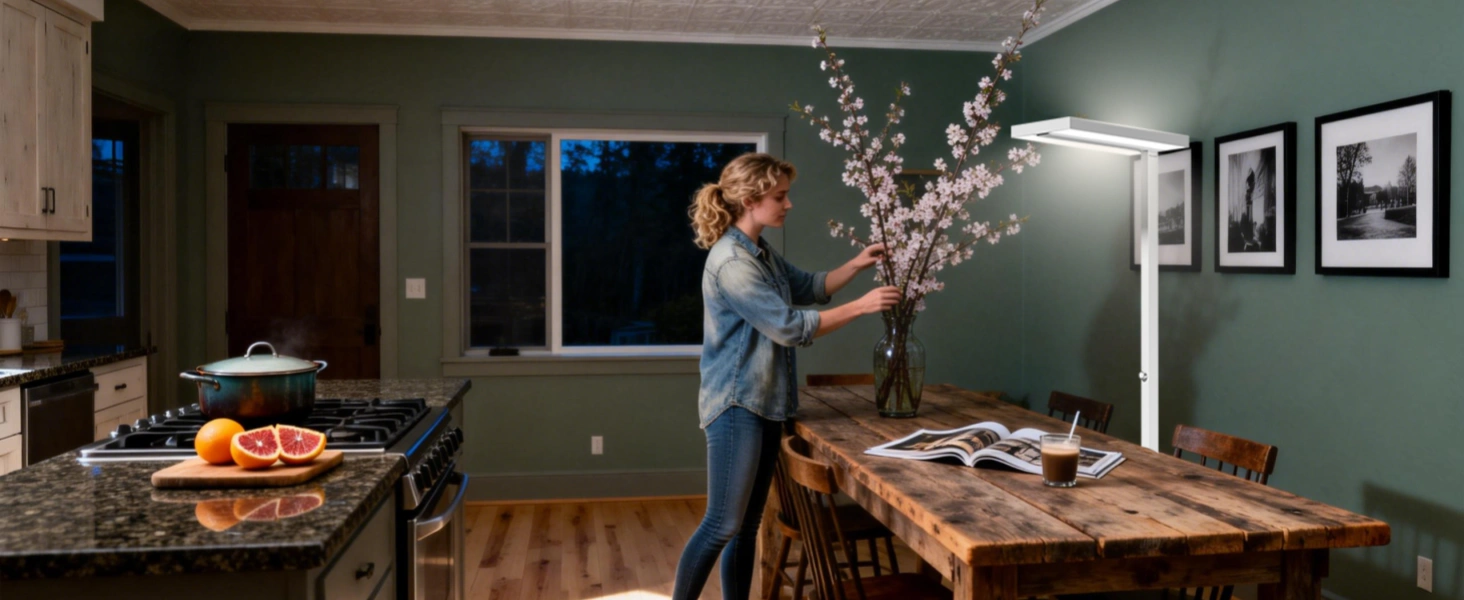
Zone 3 — Evening Wind-Down (Late Afternoon to Night): Dialed down to 10–30% via the lamp's linear rotary dimmer, the 02E shifts from a task-and-ambient powerhouse to a soft, presence-defining glow. The light remains present without overwhelming the senses — a quality that researchers in the field of chronobiology and sleep science have noted is important for supporting the body's natural evening transition. A journal focused on environmental health research has noted that reducing indoor light intensity in the evening hours supports circadian rhythm alignment, which is why having a single lamp that can genuinely reach low output levels matters more than most people realize.
How Dual-Direction Lighting Redefines Space Layers
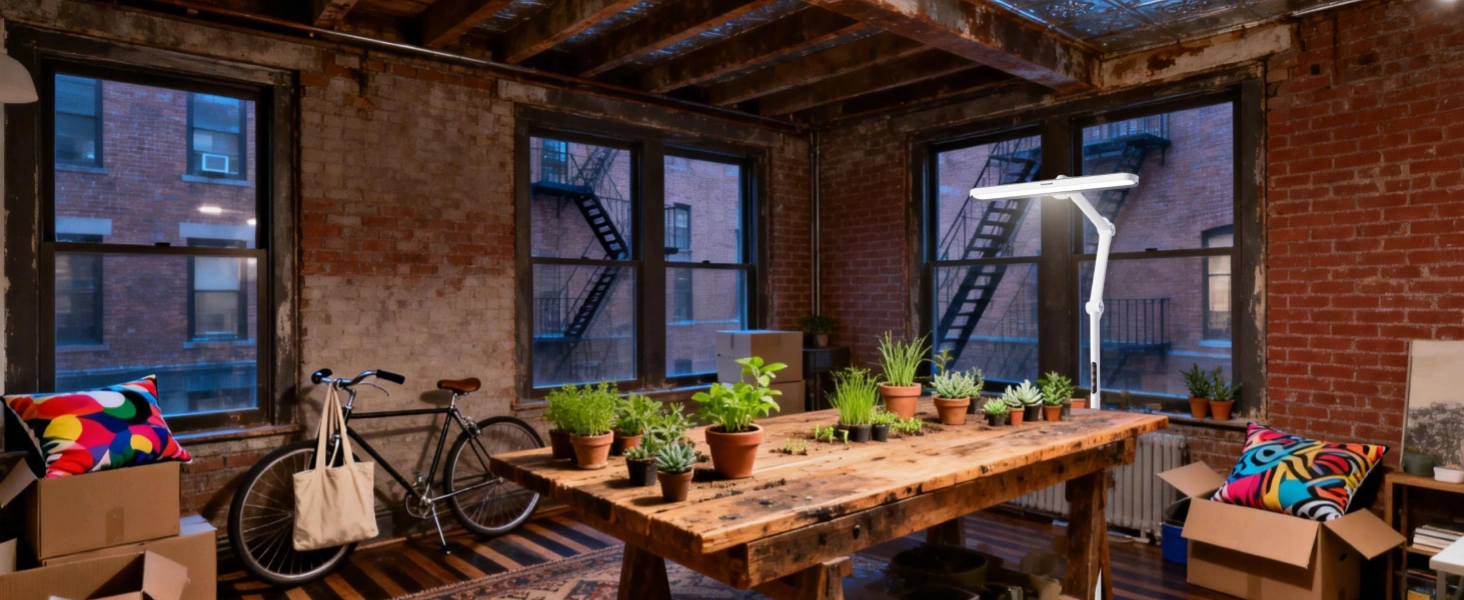
One of the most underappreciated aspects of ceiling-reflected light is its effect on perceived ceiling height. When light bounces off the ceiling, the ceiling becomes a secondary light source — and a luminous ceiling reads as higher and more open than a dark ceiling, even in rooms with standard 8-foot clearance. For city apartment dwellers accustomed to feeling like the walls are closing in, this is not a trivial benefit.
The 02E's upward output channels a substantial portion of its total lumen output toward the ceiling, creating this effect at scale. Combined with the downward diffusion, the result is a layered light environment — ambient layer above, task layer below — that is the foundational structure of professionally designed residential lighting. Interior designers working in high-end Manhattan and London residences charge substantial fees to achieve exactly this layering effect through multiple recessed and pendant fixtures. The 02E achieves a version of it from a single floor position.
Reducing Clutter Through Lighting Strategy
Clutter in small apartments is often functional rather than decorative: a pile of books under a reading lamp, a laptop stand positioned near the one outlet with adequate task light, a collection of candles assembled to make a corner feel "cozy" because the overhead fixture is too harsh to dim. These are lighting problems wearing the costume of storage problems.
When a single lamp can be dialed anywhere from 10% to 100% and covers the entire room with even, shadow-minimized light — courtesy of the 432 to 912 full-spectrum LEDs and multi-surface diffusion technology built into the 02E series — the workarounds disappear. You don't need a cluster of candles because you have genuine low-level warmth from a dimmable source. You don't need to reposition your desk chair to find the light because the light covers the room. The lamp doesn't solve your clutter problem directly, but it eliminates the functional reasons most of the clutter exists in the first place.
A Spring Apartment Reset: Lighting-First Checklist
If you're approaching your spring refresh with a lighting-first mindset, here's a practical framework for a studio or one-bedroom apartment under 700 square feet:
Step 1 — Identify your three primary activity zones. These are usually: (a) the area where you read, eat, or work; (b) the area where you relax, watch content, or entertain; and (c) the area that transitions between them. In a studio, all three may overlap in the same 10-by-12-foot zone.
Step 2 — Position a dual-direction floor lamp at the intersection. A lamp like the Honeywell 02E, placed in the corner where your main activity zone meets the room's largest wall, will cast its ceiling wash broadly and its task light directly into the zone without creating a directional hot spot.
Step 3 — Remove fixtures that serve only one function. A bedside table lamp that can only do "on" or "off"? A desk lamp that only illuminates a 2-foot circle? These are candidates for elimination once a high-range-dimming floor lamp covers the room.
Step 4 — Use the dimmer as a time-of-day cue. Start your morning at 80–100%, drop to 50–60% for afternoon work, and settle into 15–25% by 9:00 PM. This is practical chronobiology — using light intentionally to support your body's natural rhythms throughout the day.
The Honeywell 02E: What Makes It a Long-Term Investment
The 02E is not a lamp you replace next spring. Built with aerospace-grade aluminum and steel, it weighs 33.8 lbs — a deliberate design choice that prioritizes stability over portability. The U-shaped anti-tip base is engineered to anchor beneath furniture edges, a practical feature for apartments where floor space is at a premium and a falling lamp would be a genuine hazard.
Its full-spectrum chip technology — the proprietary Sunturalux system developed in partnership with Bridgelux — is calibrated to a fixed 4000K color temperature designed to replicate the quality of natural morning light as experienced indoors. The 98+ CRI (Color Rendering Index) and Rf>97 color fidelity score mean colors in your home — your art, your plants, your textiles — appear as they genuinely are rather than washed out or shifted by lower-quality LED spectra. For anyone who has felt that LED lighting makes their apartment look clinical or flat, this is the technical specification that explains why, and why a high-CRI source changes the experience fundamentally.
The 02E series has also earned EU Blue Light Safety certification (IEC/TR 62778, IEC/EN 62471) at RG0 — the lowest risk rating — and meets IEEE PAR 1789 flicker standards. For people who spend long hours working or reading under artificial light, particularly in a small apartment where there may be limited access to natural daylight, these are meaningful health-adjacent specifications.
The lamp covers up to 258 square feet of room area depending on the configuration — a footprint that encompasses most studio apartments and the primary living zones of compact one-bedrooms in cities like New York, London, and Paris.
Final Thought: Buy Light, Not Square Footage
The most honest thing you can tell someone living in a small urban apartment is this: you are unlikely to solve your space problem by moving furniture around. But you can solve your experience of the space by changing how it's lit. A living room that feels like three rooms — a reading nook, a work zone, and an evening retreat — isn't a product of square footage. It's a product of intentional, layered, dimmable light.
The Honeywell 02E is a tool for that kind of intentionality. It's the lamp you keep when everything else gets edited down.


