
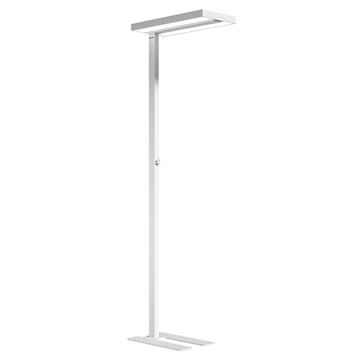


When spring arrives, many homeowners feel the urge to refresh their living spaces. For those committed to minimalist living, this seasonal renewal becomes particularly significant. In a minimalist home where every object earns its place through function and necessity, lighting stands alone as the single most impactful infrastructure decision you'll make. While furniture can be replaced and décor rotated, your choice of floor lamp affects your daily experience more profoundly than any other element in a pared-down space.
Why Lighting Functions as Home Infrastructure, Not Just Décor
Unlike furniture pieces that occupy visual space, lighting operates as continuous environmental infrastructure. Research from clinical ophthalmology practices indicates that nearly 68% of office workers experience digital eye strain symptoms, with poor lighting conditions playing a significant contributing role. In minimalist homes where activities concentrate in fewer, multi-functional spaces, the quality of your lighting becomes even more critical.
A sofa serves you only when seated. A bookshelf functions only when you need to retrieve something. But your floor lamp influences every moment spent in that space—whether you're reading, working, relaxing, or simply passing through. Academic studies have documented that workers in well-lit spaces report less eye fatigue, fewer headaches, and better productivity throughout the day. This principle applies equally to home environments, where we now spend more hours than ever before.
The Hidden Costs of Getting Your Lamp Choice Wrong
Selecting an inadequate floor lamp in a minimalist home triggers a cascade of daily compromises. Medical research demonstrates that prolonged use of poorly designed lighting can contribute to eye strain, blurred vision, headaches, and concentration difficulties. These aren't merely temporary annoyances—they accumulate into chronic discomfort that subtly degrades your quality of life.
Consider the typical evening routine: after work, you settle into your living space for reading, hobbies, or screen time. If your floor lamp produces insufficient illumination, harsh glare, or unstable light output, your eyes strain to compensate. Over weeks and months, this repeated stress manifests as persistent fatigue, reduced focus, and even mood disruption. University researchers studying visual comfort have found that illuminance levels, color temperature, and natural light availability create measurable effects on visual comfort, alertness, and worker satisfaction.
The replacement costs extend beyond money. Swapping out a floor lamp in a minimalist home disrupts the carefully calibrated aesthetic balance you've worked to achieve. Each new lamp requires fresh consideration of scale, proportion, and visual weight—decisions that consume mental energy and risk introducing dissonance into your refined space.
Why Minimalist Homes Are More Vulnerable to Poor Lighting
In conventionally furnished spaces, poor lighting can be masked or compensated for through redundancy. Multiple lamps, abundant natural light sources, or simply the visual distraction of varied décor help diffuse the impact of suboptimal illumination. Minimalist homes eliminate these safety nets deliberately.
With fewer furnishings to soften or diffuse light, every photon matters more intensely. Research on minimalist design principles emphasizes that with design elements stripped down to their simplest state, light plays a crucial role in setting the mood of the space in minimalist homes. A floor lamp producing uneven distribution or inappropriate color temperature becomes immediately apparent in such environments. The clean lines and neutral palettes that define minimalist aesthetics offer nowhere to hide lighting deficiencies.
Furthermore, minimalist living often means that single spaces serve multiple functions. Your living room might transition from morning yoga studio to afternoon workspace to evening reading nook. Each activity demands different lighting characteristics, yet in a minimalist home, you typically rely on fewer fixtures to accommodate all these needs. This places extraordinary pressure on each lamp to perform exceptionally across varied scenarios.

Spring As Your Lighting Reassessment Opportunity
Spring's lengthening days and increased natural light create the ideal conditions for evaluating your artificial lighting setup. As sunlight streams through windows later into the evening, you can more clearly observe how your floor lamp complements or conflicts with natural illumination patterns.
This seasonal transition also brings renewed energy for home improvement projects. Rather than undertaking major renovations, minimalists can achieve significant environmental upgrades through strategic lighting optimization. Consider your current floor lamp against these criteria:
Brightness and Coverage: Does your lamp adequately illuminate task areas while providing ambient light for the broader space? Quality floor lamps for minimalist homes should deliver sufficient lumens—typically 6,000 to 16,000 lumens depending on room size—to support various activities without requiring supplementary fixtures. The Honeywell 02E series, for instance, provides options ranging from 6,000 to 16,000 lumens across different models, ensuring whole-room coverage suitable for spaces up to 258 square feet.
Color Quality and Consistency: Medical studies have established that about 50% of digital device users experience symptoms of digital eye strain linked to screen and LED exposure. Your floor lamp's color rendering capabilities directly affect visual comfort during extended use. Look for fixtures offering high Color Rendering Index (CRI) values above 95, which accurately reproduce object colors and reduce eye strain compared to lower-quality alternatives.
Physical Presence: In minimalist spaces, every object contributes to or detracts from visual harmony. Your floor lamp should command appropriate scale—substantial enough to anchor its corner without overwhelming the room. At 33.8 pounds, the Honeywell 02E establishes solid physical presence through aerospace-grade materials while maintaining clean, industrial-modern aesthetics compatible with minimalist principles.
Longevity and Build Quality: Minimalist philosophy values enduring quality over disposable convenience. Floor lamps constructed from premium materials—aluminum, steel, tempered glass—justify their space through decades of reliable service. Inferior lamps require replacement within years, contradicting minimalist values of thoughtful, lasting ownership.
Making the Right Choice for Stable, Long-Term Living
For individuals planning to stay in their homes long-term, lighting decisions carry amplified significance. You're not selecting a lamp for this season or this year—you're choosing infrastructure that will shape your daily experience for the next decade or longer.
The Honeywell 02E series exemplifies this long-term thinking through several design decisions. Its 4,000K color temperature mimics mid-morning natural daylight—specifically, the quality of light found in Greenwich at 10 AM. This consistency means your circadian rhythms receive stable environmental cues regardless of actual time or season. Unlike adjustable color-temperature lamps that require constant manual optimization, the 02E's fixed output removes decision fatigue while delivering scientifically validated illumination properties.
The lamp's upward and downward light distribution pattern creates layered illumination without requiring multiple fixtures. Downward-directed light (ranging from 2,900 to 3,376 lumens depending on model) provides task illumination, while upward-cast light (4,872 to 12,624 lumens) bounces off ceilings to generate ambient fill. This dual approach addresses the fundamental challenge of minimalist lighting: achieving comprehensive coverage from minimal sources.
Research into lighting ergonomics confirms that providing light around visual tasks diminishes both visual fatigue and eyestrain, supporting the value of distributed illumination patterns over single-source solutions.

Final Considerations: Investing in Your Daily Foundation
Your floor lamp represents more than a purchase—it's an infrastructure investment comparable to HVAC systems or quality windows. In minimalist homes where every element undergoes intense scrutiny, settling for mediocre lighting contradicts the core philosophy of intentional, quality-focused living.
As you reassess your space this spring, consider whether your current lighting genuinely serves your long-term needs or merely occupies floor space. Does it provide adequate illumination for aging eyes, which research shows require up to twice as much light as younger eyes need? Will it continue meeting your needs as your activities and priorities evolve over coming years?
The right floor lamp choice creates invisible infrastructure—present when needed, unobtrusive when not, and consistently supportive of whatever activities fill your days. In minimalist homes where each object must justify its existence through daily value, few items prove more essential than the lamp that quite literally illuminates everything else.
Spring's arrival offers both metaphorical and practical illumination for this decision. As natural light reveals corners that winter darkness obscured, let it also spotlight whether your current lighting truly serves the minimalist, long-term home you're building. The lamp you choose today will shape thousands of evenings, hundreds of projects, and countless quiet moments over the years ahead. Make the choice count.


